

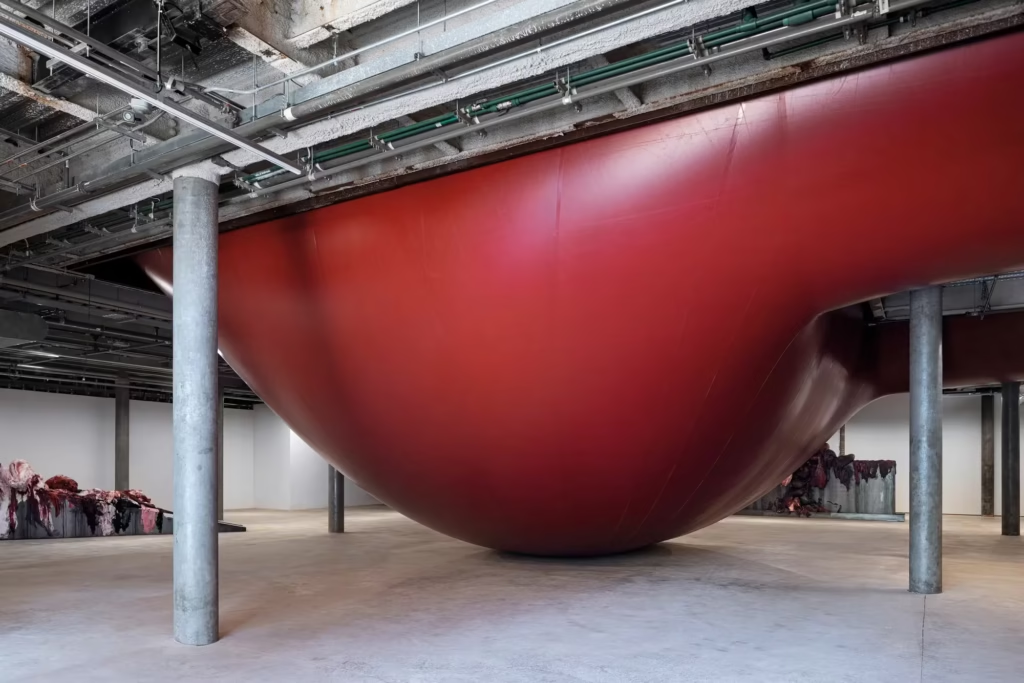
Imagine standing inside a room where a sculpture doesn’t just sit in the space – it consumes it. Where something so enormous presses against the walls and descends from the ceiling that you genuinely lose your sense of where the artwork ends and the building begins. That’s what it feels like to be in the presence of Anish Kapoor’s work. And this summer, that experience is coming to the Hayward Gallery on the South Bank.
From Tuesday 16 June to Sunday 18 October 2026, one of Britain’s most celebrated sculptors takes over the entire Hayward Gallery building – every room, every terrace, ceiling to floor – in what promises to be the most talked-about art exhibition in London this year. New monumental works sit alongside career-defining pieces, and the result is described as creating an uncanny sensation of awe and wonder. Which is a very polished way of saying: it’ll probably make your jaw drop.
Here’s the thing – if you’ve ever stood in Millennium Park in Chicago and watched strangers walk up to Cloud Gate (the giant reflective bean-shaped sculpture) with wide eyes and open mouths, you already know a little of what’s coming. Now multiply that sensation, put it indoors, and give it an entire gallery to fill. That’s this summer.
Who Is Anish Kapoor?
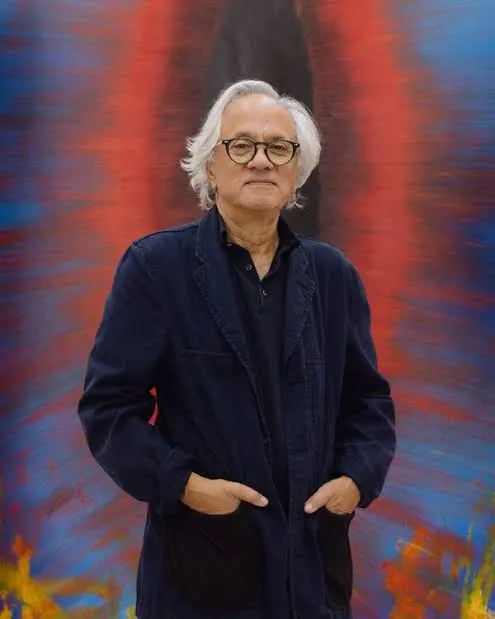
Anish Kapoor is a British-Indian sculptor born in Mumbai in 1954, who has spent the last four decades quietly becoming one of the most important artists working anywhere in the world. He’s not an artist who deals in small gestures. Everything Kapoor makes feels like it was conceived at a different scale to ordinary human experience.
You’ve almost certainly seen his work even if you didn’t know his name. Cloud Gate – that enormous mirrored bean in Chicago’s Millennium Park – is one of the most photographed public artworks on earth. The ArcelorMittal Orbit, that crackers twisting red tower at Queen Elizabeth Olympic Park in Stratford, is his too. In 2002, he filled the Turbine Hall at Tate Modern with Marsyas – a colossal PVC trumpet so enormous it stretched the length of the building. People stood under it looking genuinely dazed.
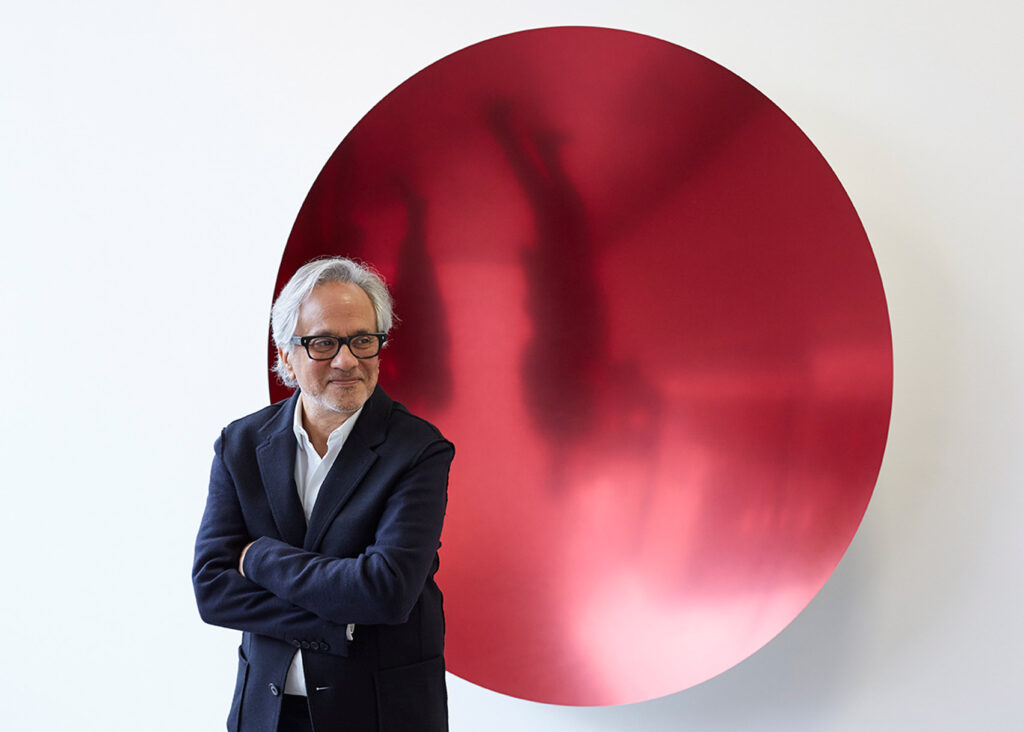
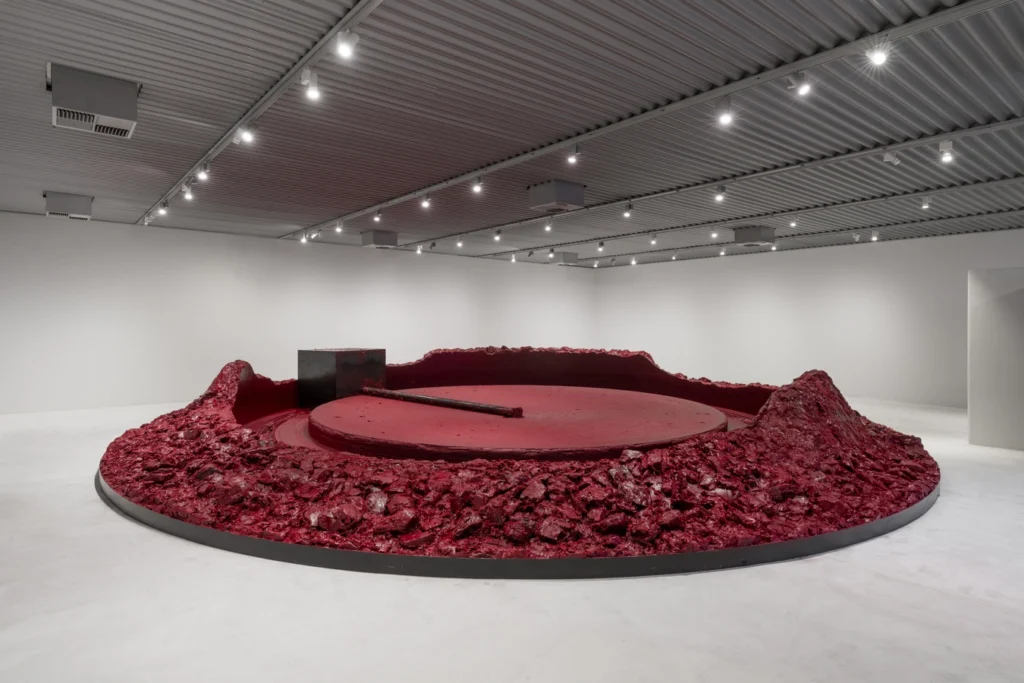
What makes Kapoor different isn’t just scale, though scale is certainly part of it. His work consistently returns to ideas about the void, about perception, about what we see versus what’s actually there. Some of his sculptures appear to open holes in the wall. Others are so deeply pigmented – saturated blues, reds, blacks – that they seem to absorb light rather than reflect it. His vantablack works, created using the blackest black material ever produced, look less like sculptures and more like tears in the fabric of reality. Brilliant, unsettling stuff.
He was awarded the Turner Prize in 1991. He represented Great Britain at the Venice Biennale in 1990. He received a CBE in 2003 and a knighthood in 2013. The credentials are impeccable, but honestly, none of that matters as much as the simple fact that standing in front of his work is a proper experience.
What to Expect at the Hayward This Summer
This is Kapoor’s first return to the Hayward Gallery since 1998 – a 28-year gap. That 1998 show was the first major UK survey of his work. This one is something bigger: a full takeover.
The exhibition is simply titled Anish Kapoor. No subtitle needed. Curated by Ralph Rugoff – the Hayward Gallery’s outgoing director after 20 years in the role, and one of the most respected figures in contemporary art curation – the show fills the entire gallery building. And we mean the entire building. Works press against the walls and floors. They descend from the ceiling. They spill out onto the terraces.
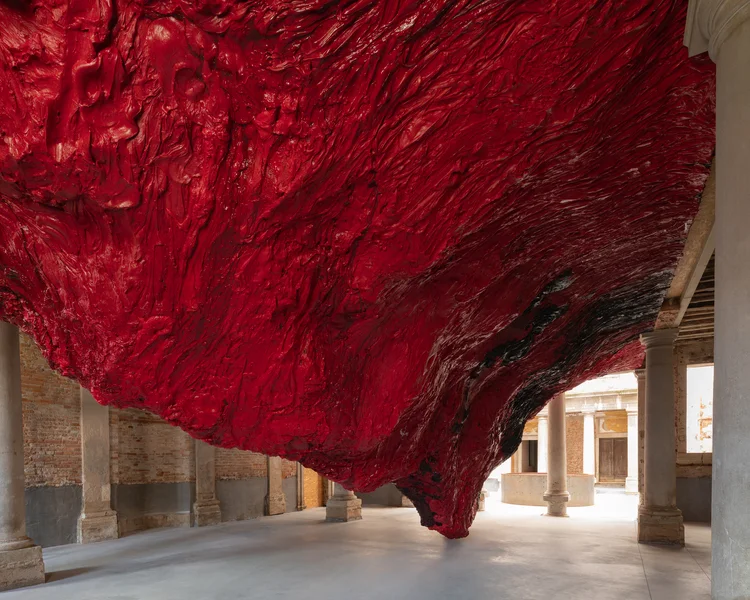
The effect, according to early descriptions, is one of those shows where you lose yourself slightly. Where the scale and the strangeness of it all produces something closer to a physical sensation than an intellectual one. That’s exactly what the Hayward’s raw concrete architecture is built for – it’s a brutalist building that doesn’t prettify itself, and Kapoor’s work responds brilliantly to spaces that have some grit to them.
New monumental works sit alongside seminal pieces from across his career, so you get the full arc of what he’s been doing. First-timers will be introduced to a body of work that’s genuinely astonishing. People who’ve followed his career for decades will see new things they haven’t seen before. That combination is rare, and it’s a proper reason to go.
Tickets are approximately £22, and this is one of those shows you’ll want to book in advance. Word is going to get out fast.
Part of Something Bigger – The Southbank Centre at 75
This exhibition isn’t happening in isolation. It’s part of the Southbank Centre’s 75th anniversary programme – a year-long celebration of one of the world’s great cultural institutions. The Southbank Centre has been at the heart of London’s cultural life since 1951, and its 75th anniversary is a proper occasion.
Staging a full Anish Kapoor takeover of the Hayward as part of that programme is a statement. It says: here is an artist who matters, in a building that matters, as part of a year that matters. The extra cultural weight of that context gives the exhibition a significance beyond even the considerable significance of the work itself.
If you’re planning a South Bank day this summer – and honestly, why wouldn’t you be – this is the anchor around which everything else can be built.
From the Void to the Board – Games Worth Playing After
Kapoor’s whole world is about perception, illusion and pattern – the way we make sense of shapes, spaces and visual information. And if that sounds like it could describe a great board game, that’s because it absolutely can.
After a couple of hours having your sense of scale thoroughly dismantled, we’d suggest settling in with Azul – a gorgeous abstract tile-laying game about pattern and visual beauty that feels genuinely meditative to play. It’s one of those games where you spend the whole time admiring what’s on the table in front of you. Totally fitting. Or try Sagrada, where you draft coloured dice to fill stained glass window patterns – architectural, visual, quietly hypnotic.
Both are in our library and both are the kind of games that reward the contemplative, spatially-minded headspace a Kapoor exhibition tends to leave you in. Browse the full library at games.draughtslondon.com – there are over 1,000 games to choose from, and our team will always point you in the right direction.
Come and Debrief With Us at Draughts Waterloo
Here’s the beautiful thing about visiting the Hayward Gallery in 2026: we’re a 5-10 minute walk away along the South Bank.
We’re at Arch 16, Leake Street, SE1 7NN – inside the iconic Leake Street Graffiti Tunnel, right under Waterloo station. You might know it as the tunnel where street artists have been legally painting the walls since 2008. It’s a brilliant space, a little unexpected, and about as far from a corporate venue as you can get. Less than two minutes from the London Eye, and a comfortable stroll from the Hayward along the South Bank.
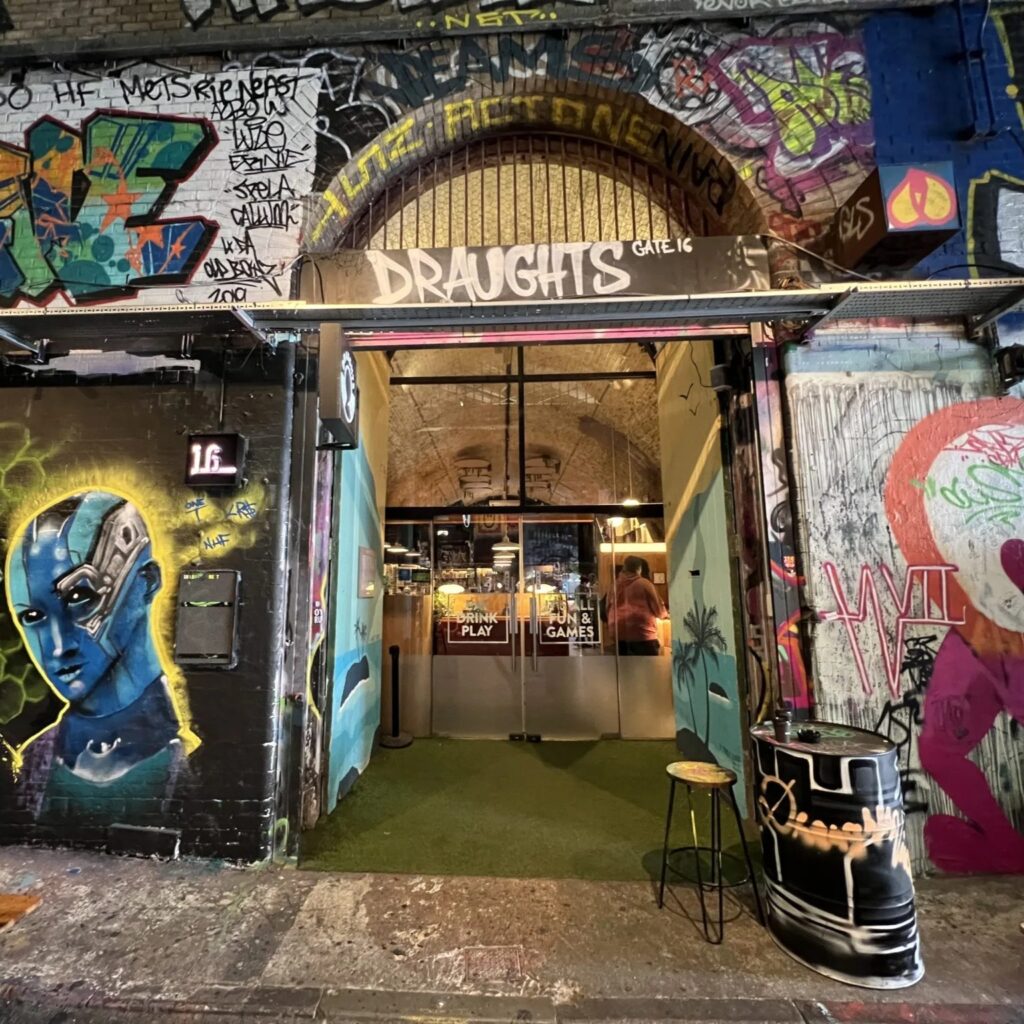
After you’ve spent an afternoon inside Kapoor’s world – standing in front of something that shouldn’t be possible, having your perception thoroughly messed with in the best possible way – what you want is somewhere to sit down properly, order something good, and talk about what you just saw. That’s exactly what we’re here for.
We’ve got a proper kitchen, a full bar, and over 1,000 board games. Whether it’s a post-gallery glass of wine and a quiet game, or a full evening with food and a group of friends, we’re the obvious next stop. The kind of afternoon where you say “right, one drink and then we’ll head off” and then look up three hours later.
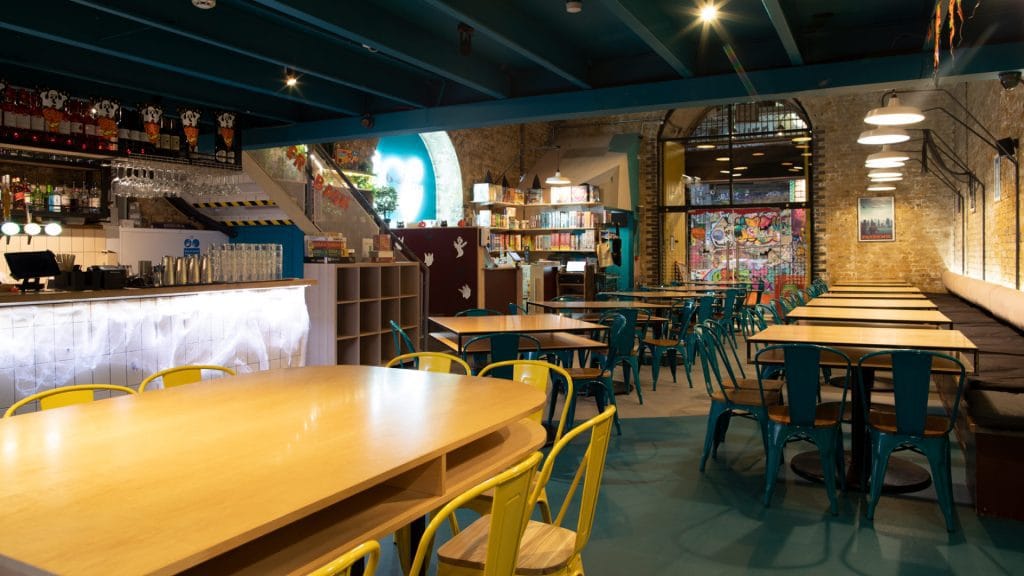
Book a table in advance – especially if you’re coming on a weekend – at draughtslondon.com. We’d hate for you to walk down Leake Street and not be able to get a seat.
Practical Tips for Your Hayward Visit
- Getting there is easy. Waterloo station is your hub – it’s served by the Jubilee, Bakerloo and Northern lines, plus National Rail from across the country. The Hayward Gallery is a short walk along the South Bank from Waterloo. Simple.
- Book your exhibition tickets in advance. At approximately £22, this isn’t a drop-in affair. Kapoor’s work attracts serious crowds and this show – part of the Southbank Centre’s 75th anniversary year – is going to be one of the big ones. Get tickets sorted before you travel.
- Midweek mornings are your best bet for a quieter visit. The Hayward can get busy on weekends, especially for a show of this profile. If your schedule allows it, a Tuesday or Wednesday morning gives you more room to actually stand in front of things and take them in properly.
- There’s plenty else on at the Southbank Centre this summer. Harry Styles curates Meltdown – the Southbank Centre’s famous artist-curated festival – from 11-21 June, right as the Kapoor show opens. The wider Southbank Summer programme runs across the season with outdoor events, performances and more. A brilliant week to be on the South Bank.
- Pair it with a broader South Bank afternoon. The South Bank is one of the best stretches of London for gallery-hopping and wandering. There’s plenty to see within easy walking distance of the Hayward. Make a proper day of it.
Frequently Asked Questions about Anish Kapoor at Hayward Gallery
When is the Anish Kapoor exhibition at the Hayward Gallery?
The exhibition runs from Tuesday 16 June to Sunday 18 October 2026. The Hayward Gallery is open Tuesday to Sunday – check the Southbank Centre website for specific opening times and any late-night openings during the run.
Where is the Hayward Gallery?
The Hayward Gallery is part of the Southbank Centre on the South Bank of the Thames, London SE1. It’s a short walk from Waterloo station along the riverside, close to the Royal Festival Hall and the National Theatre.
Who is Anish Kapoor?
Anish Kapoor is a British-Indian sculptor, born in Mumbai in 1954, who has lived and worked in London since the 1970s. He’s one of Britain’s most celebrated and internationally recognised artists, known for monumental public sculptures and immersive installations that explore ideas of scale, the void, colour and perception. He was awarded the Turner Prize in 1991 and a knighthood in 2013.
What are Anish Kapoor’s most famous works?
Cloud Gate (2006) – the giant reflective bean in Chicago’s Millennium Park – is arguably his most recognised public work. Marsyas (2002), the colossal PVC trumpet that filled Tate Modern’s Turbine Hall, was a landmark moment in British contemporary art. The ArcelorMittal Orbit at Queen Elizabeth Olympic Park in Stratford is his largest permanent public work in the UK. His vantablack series, using the blackest material known to science, has been widely discussed in recent years.
What is the Hayward Gallery?
The Hayward Gallery is a world-leading contemporary art gallery inside the Southbank Centre on London’s South Bank. Opened in 1968, it occupies a striking brutalist building and stages major temporary exhibitions by leading international artists. It doesn’t hold a permanent collection – every show is a curated temporary exhibition.
How much are tickets for the Anish Kapoor exhibition?
Tickets are approximately £22. Booking in advance is strongly recommended, particularly for weekends. Tickets are available through the Southbank Centre website.
How do I get to the Hayward Gallery?
The easiest route is via Waterloo station, which is served by the Jubilee, Bakerloo and Northern underground lines, as well as National Rail services from across the UK. From Waterloo, it’s a short walk along the South Bank to the Hayward Gallery. Alternatively, Embankment or Temple stations on the District and Circle lines are a pleasant walk across the river.
Is the Anish Kapoor exhibition suitable for families?
Yes – Kapoor’s work is visually spectacular and genuinely awe-inspiring for visitors of all ages. The immersive, large-scale nature of the installations tends to engage younger visitors in a way that more conventional gallery shows don’t. That said, the exhibition involves large and potentially disorientating works, so it’s worth being prepared for that with very young children.
How long does the Anish Kapoor exhibition take?
Most visitors spend between 1.5 and 2.5 hours in the exhibition, depending on how much time they spend with individual works. Given that it fills the entire gallery building including the terraces, this is a full visit rather than a quick pop-in.
What else is on at the Southbank Centre in summer 2026?
Harry Styles curates the Southbank Centre’s Meltdown festival from 11-21 June 2026, overlapping with the opening of the Kapoor show. The broader Southbank Summer programme runs across the season with outdoor events, performances, markets and more. It’s a brilliant time to be on the South Bank.
Where should I eat near the Hayward Gallery?
We’re at Arch 16, Leake Street, SE1 7NN – a 5-10 minute walk along the South Bank from the Hayward Gallery. We’re a bar, restaurant and board game café with over 1,000 games, tucked inside the famous Leake Street Graffiti Tunnel under Waterloo station. It’s a brilliant post-gallery spot. Book ahead at draughtslondon.com.
What is the Leake Street Graffiti Tunnel?
Leake Street is a tunnel under Waterloo station that’s been a legally sanctioned street art location since Banksy’s Cans Festival in 2008. The walls are constantly changing as artists paint over and over them – it’s one of London’s most distinctive creative spaces. We’re based inside it at Arch 16, which means visiting us is a cultural experience in itself.
Has Anish Kapoor shown at the Hayward Gallery before?
Yes – the Hayward Gallery staged the first major UK survey of Kapoor’s work back in 1998. This summer’s exhibition marks his return to the gallery 28 years later, and on a significantly larger scale. The whole building is his.
What is the Southbank Centre’s 75th anniversary?
The Southbank Centre – the arts complex that includes the Royal Festival Hall, Queen Elizabeth Hall, Purcell Room and Hayward Gallery – marks its 75th anniversary in 2026. The Anish Kapoor exhibition is part of the anniversary programme, which runs across the year with major commissions, exhibitions and events.