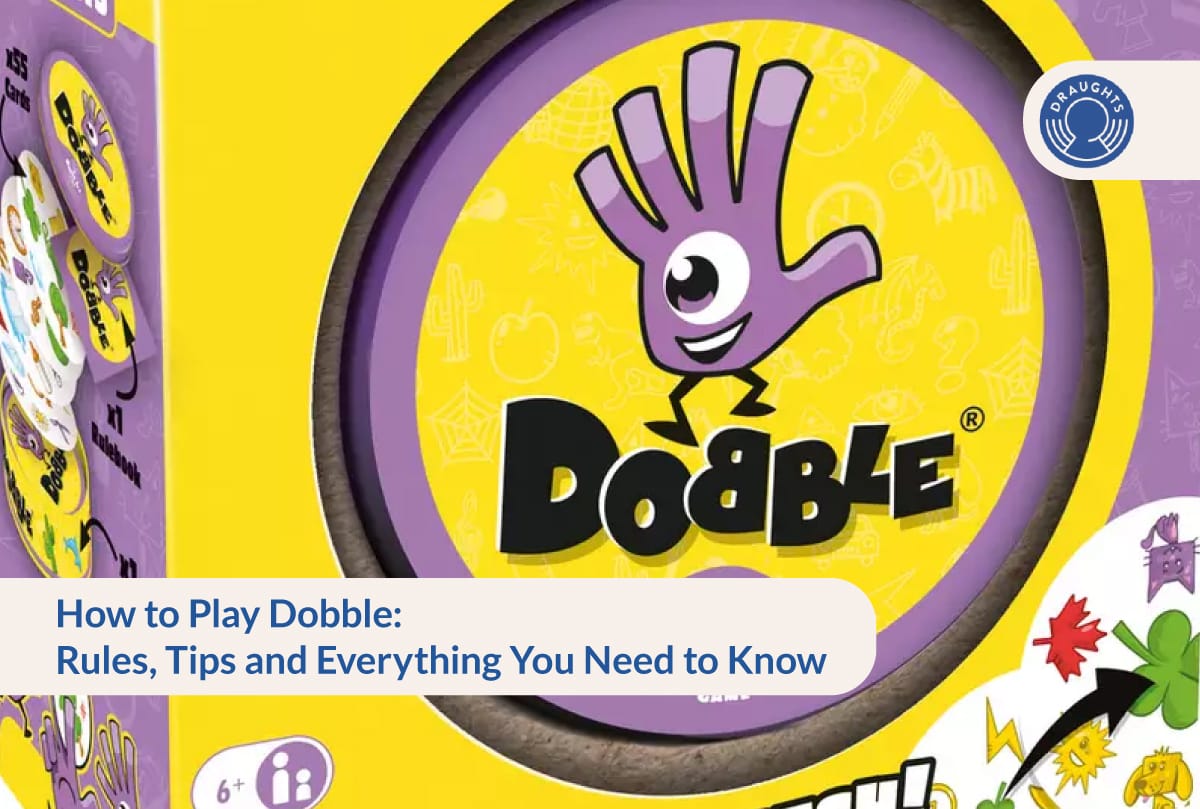
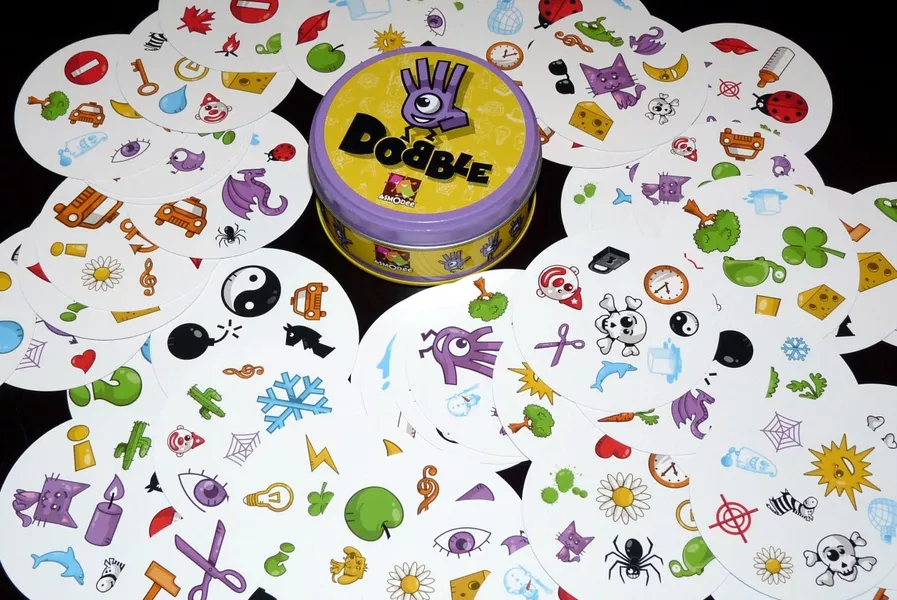
Two cards. Find the symbol they share, say it first.
That’s the entire game, and written down like that it sounds like something you’d give a child to keep them quiet on a train. Then you play it, and within ninety seconds someone is slamming the table, someone else is arguing about whether that’s a snowflake or a star, and at least one person is shouting a symbol that is definitively not on either card.
Dobble is the most reliably chaotic thirty minutes in our library, and it’s been one of the most-requested games at Draughts for years.
What Is Dobble?
A card game of pure visual pattern recognition. No turns, no hidden information, no rules to speak of. Every card is covered in symbols and you’re hunting for the one that appears on both.
It was published in 2009, designed by Denis Blanchot, Guillaume Gille-Naves, Igor Polouchine and Jacques Cottereau. In Europe it’s Dobble. In North America it’s Spot It!. Same game, different name on the box – ours is listed as Spot It! in the library, but everyone calls it Dobble.
Two to eight players, about 15 minutes, minimum age 6. That last number tells you most of what you need to know about the learning curve.
The Bit Nobody Expects: The Maths
Here’s what makes Dobble properly clever, and it’s not the gameplay.
Every card has 8 symbols. The deck has 55 cards. And any two cards you pull out of that deck share exactly one symbol. Not two. Not none. Exactly one, every single time.
That shouldn’t be possible, and working out how it’s done takes you into a branch of maths called finite projective planes – systems of points and lines where any two lines cross at exactly one point. Build a deck on that structure and you can get 57 cards of 8 symbols each where every possible pairing shares precisely one. Dobble uses 55 of them, with 57 unique symbols across the deck.
The practical upshot: when you’re staring at two cards convinced there’s been a printing error, there hasn’t been. The match is there. You just can’t see it, and everyone else is about to.
How You Actually Play
Find the matching symbol, say it out loud, be faster than everyone else. Every version of the game is a variation on that.
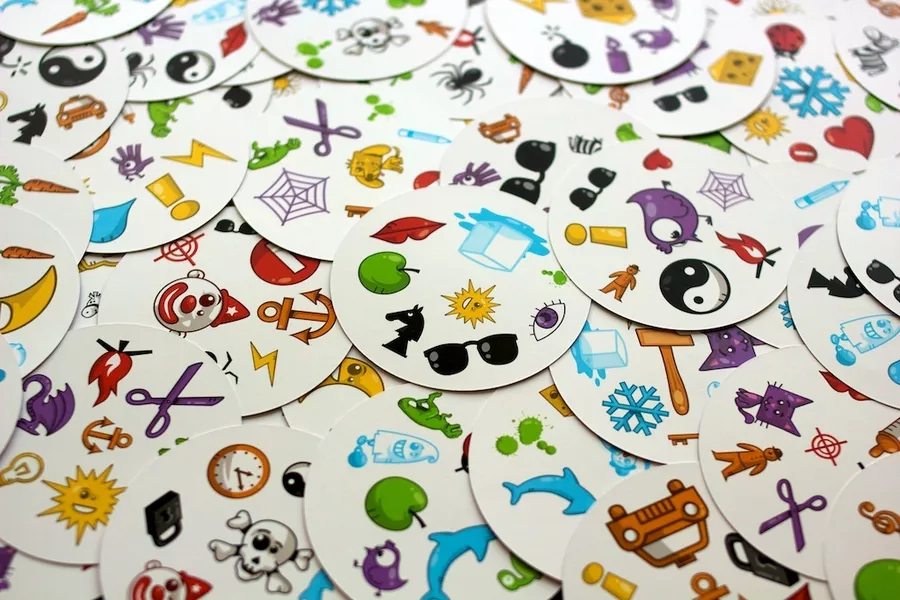
One thing to know before you start: symbols change size between cards. A tiny anchor on one card is an enormous anchor on the next. This is completely deliberate and it’s the source of roughly 90% of all Dobble arguments, because your brain desperately wants to match by size and Dobble punishes that instinct without mercy.
There are five mini-games in the box.
The Tower is where everyone starts. One card face-up in the middle, everyone else holding a face-down pile. Flip your top card, find the match with the centre card, claim it. Most cards at the end wins.
The Well turns it around. One card in the centre, cards in your hand, and you’re racing to dump yours onto the pile by matching. First person empty-handed wins.
The Gift is the tactical one. Everyone has a face-up card. Match yours to someone else’s, name it, and hand yours over. Fewest cards at the end wins – so you’re offloading as fast as you can while four other people try to do the same thing to you.
Poisoned Gift is the same mechanic with the objective flipped. Now you want the cards. Getting rid of the most wins, so you’re trying not to hand yours over while the game keeps forcing your hand.
The Towering Inferno mixes several of the above and is worth saving until everyone’s warmed up.
Getting Better at It
Dobble is mostly speed, but there are a couple of things that genuinely help.
Scan the other card, not yours. Most people work through their own card symbol by symbol and check each one against the centre. It’s faster to pick something off the centre card and hunt for it on yours. Try it once and you’ll feel the difference immediately.
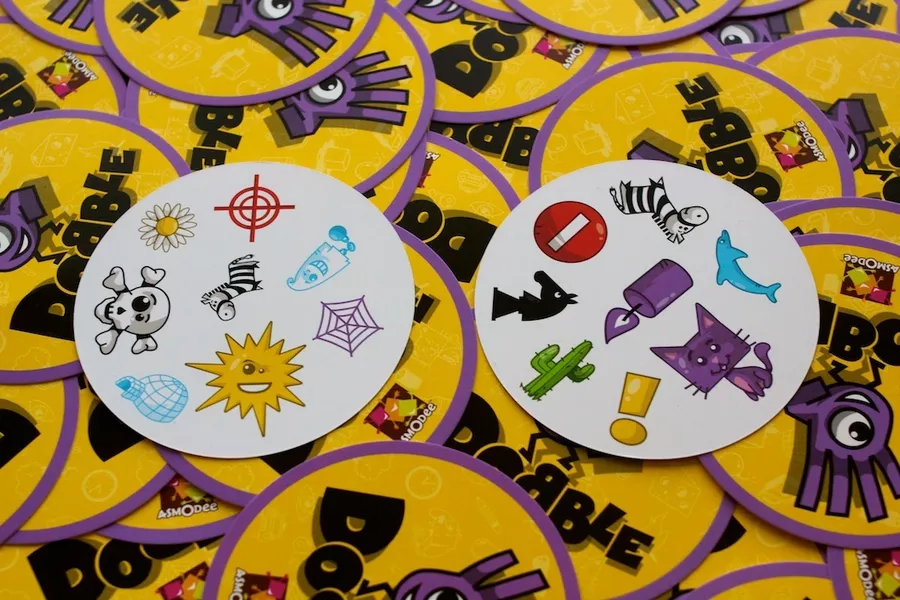
Ignore size completely. It’s a trap and it’s designed to be one. Lock onto shape and colour.
Learn the weird symbols. There are 57 of them and after a few games you’ll start clocking the rare ones – the daisy, the dragon, the clown – and they become instant wins when they come up.
And don’t call it until you’re sure. Most of the mini-games penalise a wrong shout, and there’s nothing worse than confidently yelling “LIGHTNING BOLT” at a card that has no lightning bolt on it. Slow and right beats fast and wrong.
Who It’s For
Dobble is the game we hand people when not everyone’s arrived yet and the first round of drinks is still coming. It’s perfect for that.
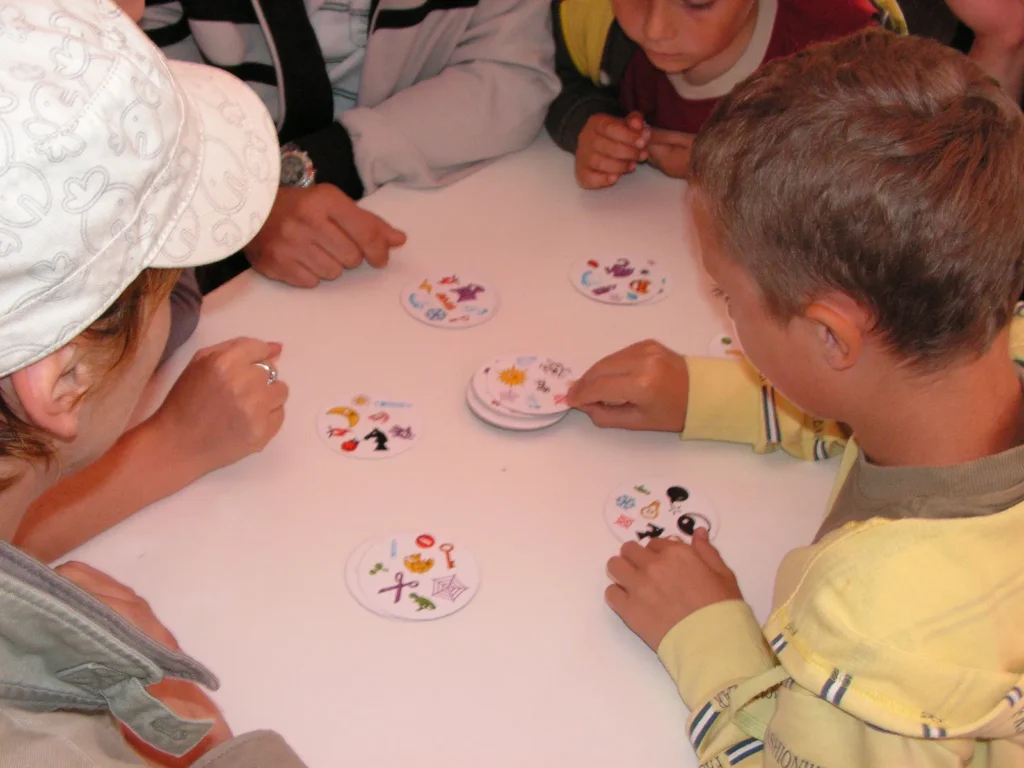
It’s also ideal for mixed-age tables, for groups where someone’s nervous about board games, and for competitive people who want something decided by pure reflex rather than an hour of planning.
Where it doesn’t work: it’s entirely visual, so it’s not suitable for everyone. And if your group wants something with real depth, Dobble won’t scratch that itch – play it for fifteen minutes as a warm-up and then move on to something with more to chew on.
Editions
The original deck is the one to play. Dobble Connect (also in our library) is a team version where you’re building lines of four cards, which adds a layer of structure to the speed – worth trying if you’ve played a lot of the standard game.
If you want to turn a night of Dobble Connect into more than just a quick game, we’ve put together a full family game night guide covering team setups, house rules and tournament formats.
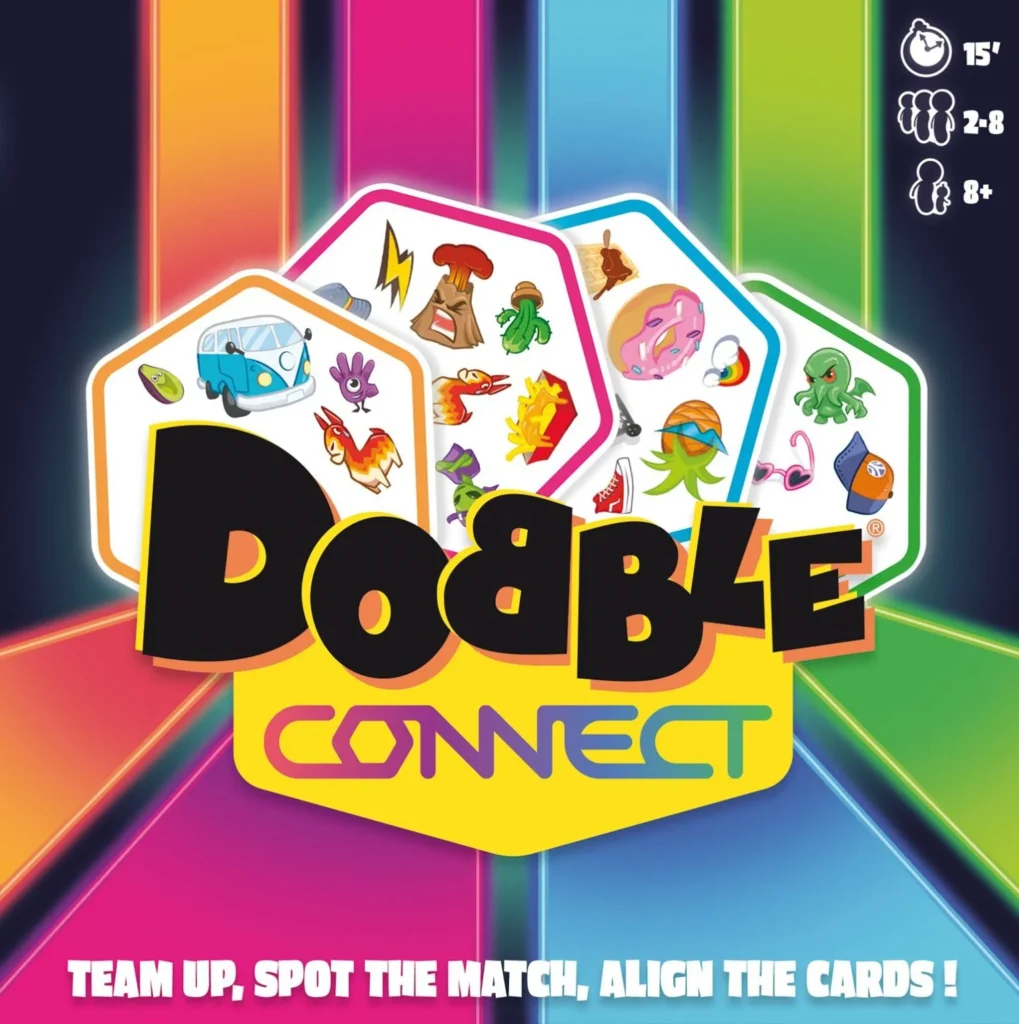
There are also themed decks – Harry Potter, Marvel, animals, and plenty of others. They play identically. Fine as gifts, no real reason to seek them out otherwise.
Play It at Draughts
We’ve got Dobble at both venues – Stratford at 5 Aquatics Walk inside Queen Elizabeth Olympic Park, and Waterloo at Arch 16 on Leake Street inside the graffiti tunnel.

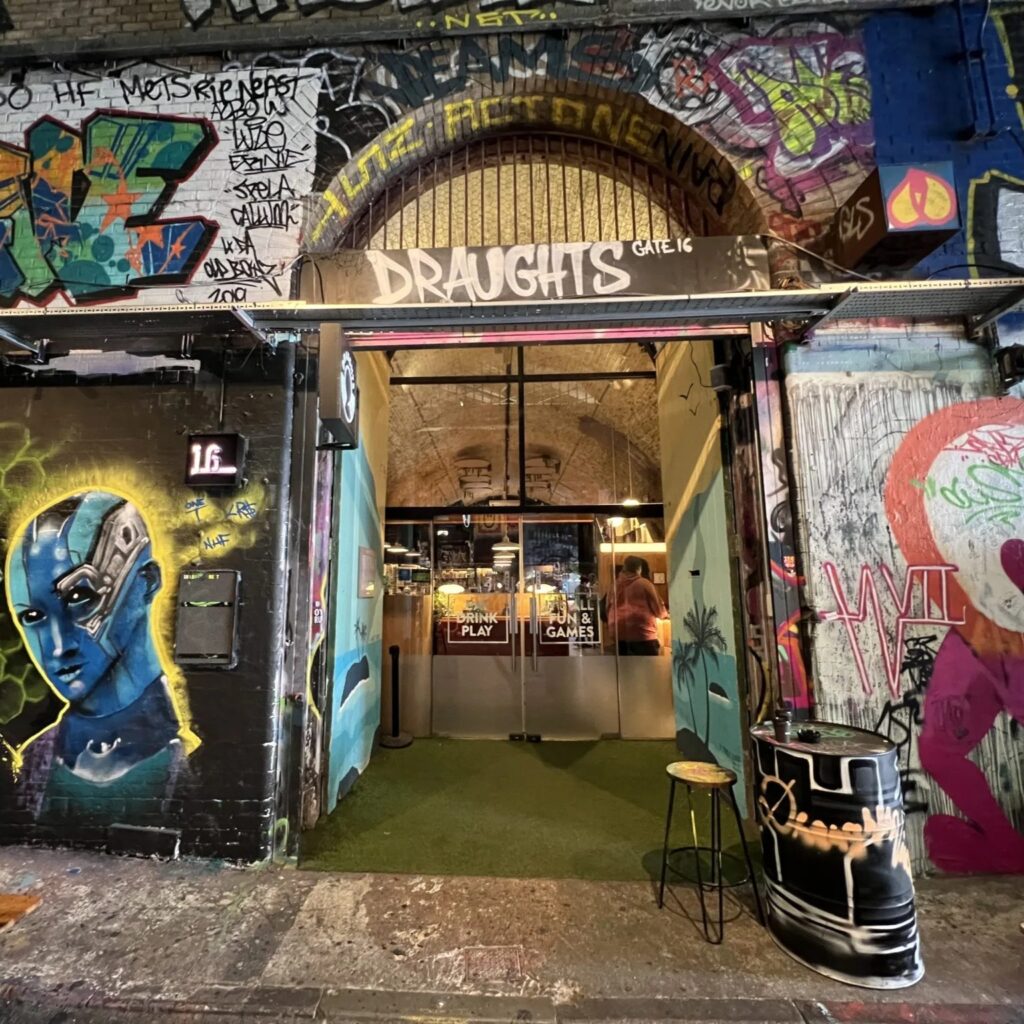
It’s one of the most-requested games we have, mostly because it’s the ideal opener. Loud, fast, needs no explanation, and it gets a table properly awake before you settle into something longer.
Over 1,000 games, a full bar and a proper kitchen. Book a table at draughtslondon.com.
Frequently Asked Questions
What is Dobble?
Dobble is a fast-paced card game where every card has 8 symbols and any two cards in the deck share exactly one matching symbol. Players race to spot and name the match before anyone else. It plays 2 to 8 people and takes around 15 minutes.
How do you play Dobble?
Find the one symbol that appears on both cards in play and say it out loud before anyone else does. Dobble includes five mini-games in the box, each a variation on that core mechanic – collecting cards, getting rid of them, or passing them to opponents.
How many cards are in a Dobble deck?
Fifty-five cards, each with 8 symbols. Any two of them share exactly one symbol, guaranteed by the mathematical structure the deck is built on.
What is the maths behind Dobble?
Dobble is based on a finite projective plane. In a projective plane of order 7, any two lines intersect at exactly one point. Applied to cards, that allows up to 57 cards with 8 symbols each where every pairing shares exactly one symbol. The Dobble deck uses 55 of those possible cards.
How many symbols are in Dobble?
Fifty-seven unique symbols across the deck. Each card shows 8 of them.
What is the difference between Dobble and Spot It?
They’re the same game – Dobble in Europe, Spot It! in North America. Gameplay and card design are identical. Our library lists it as Spot It!.
How many players can play Dobble?
Two to eight. It’s best with three or more – at two players some of the mini-games lose their edge, though The Well and The Gift both work well head-to-head.
How long does Dobble take to play?
Around 15 minutes for a single game. Because there are five mini-games in the box, most groups end up playing two or three back to back, so a full session runs 30 to 45 minutes.
What age is Dobble suitable for?
Six and up. There’s no reading and no prior knowledge required, just visual recognition and speed, which makes it genuinely accessible to younger players. It also means kids can beat adults, which they enjoy enormously.
Is Dobble good for large groups?
Yes. It handles up to eight, rounds are very short, and people can join or drop out between games without disrupting anything. It’s a good option when not everyone in your group wants to commit to something longer.
Is Dobble good for beginners?
It’s one of the best there is. Nothing to memorise, no setup, no experience needed. You can explain it in thirty seconds and be playing immediately.
Can you play Dobble at Draughts?
Yes – we have Spot It! (the original Dobble) at both Draughts Stratford (5 Aquatics Walk, Queen Elizabeth Olympic Park, E20 2AS) and Draughts Waterloo (Arch 16, Leake Street, SE1 7NN). Ask our team when you arrive. Book at draughtslondon.com.