If you’re heading to the ArcelorMittal Orbit – whether you’re riding the world’s longest tunnel slide or just taking in 20 miles of London from the top – you’re going to want somewhere to eat and drink before or after. Here’s the answer: we’re at Draughts, 5 Aquatics Walk, inside Queen Elizabeth Olympic Park. A bar, restaurant and board game venue with over 1,000 carefully curated board games, we’ve built a library with the perfect game for every group, five minutes on foot from the Orbit. Come early and settle in, or come after the slide and decompress with food and something cold. Either works.
And while we’re at it – here’s everything you need to know about the Orbit itself. Because it has a great story worth knowing.
It started in a cloakroom. Not in an architect’s studio, not in a planning office, not in the Mayor of London’s gleaming headquarters. A cloakroom. At the World Economic Forum in Davos, 2009, Boris Johnson collared Lakshmi Mittal – the chairman and CEO of the world’s largest steel company, ArcelorMittal – and pitched him an idea: a landmark sculpture to mark London’s hosting of the 2012 Olympic Games. The conversation lasted 45 seconds. Mittal said yes. Johnson later confirmed it himself: “This was conceived in a 45-second conversation in a cloakroom.” And that, more or less, is how east London ended up with the most gloriously strange thing in its skyline.
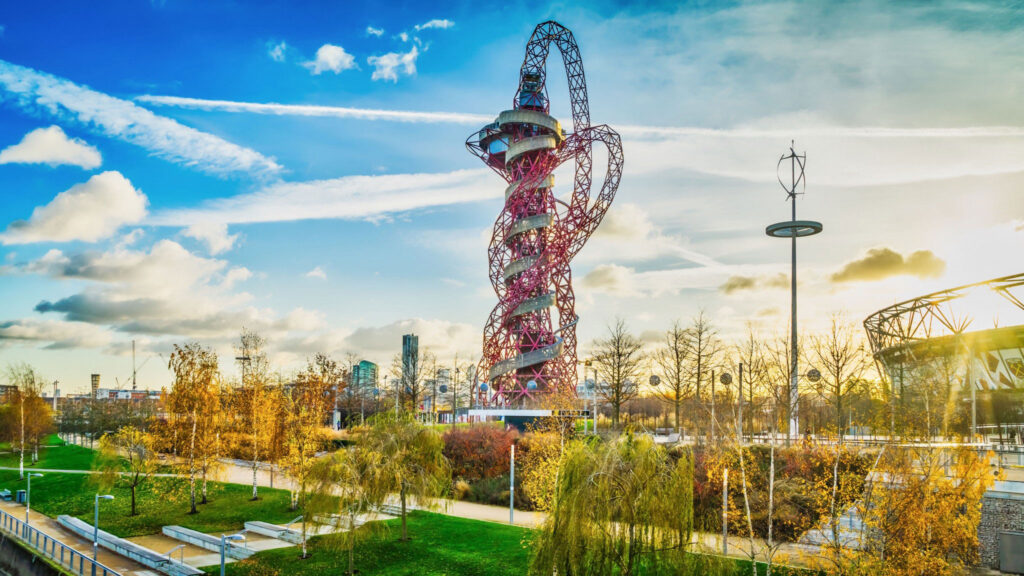
The ArcelorMittal Orbit now stands 114.5 metres tall in the heart of Queen Elizabeth Olympic Park. It is the UK’s tallest sculpture – 22 metres higher than the Statue of Liberty, since you’re asking – and it’s been delighting, baffling and occasionally terrifying visitors since the Olympics opened. It went on to acquire the world’s tallest and longest tunnel slide. There are plans for a 440-metre zipline. The ambition is absolutely crackers, and it is brilliant.
How the ArcelorMittal Orbit was designed
After that Davos handshake, a competition was held. Around 50 submissions came in. The winner was sculptor Sir Anish Kapoor working alongside engineer Cecil Balmond. Their design – a looping, spiralling lattice of tubular steel that twists and doubles back on itself – was immediately divisive in the way that genuinely interesting public art always is. Some people loved it. Some people really didn’t, everyone kept looking at it.
The looping structure was designed to evoke the orbital trajectory of objects in space – which is where the name comes from. Look at it from different angles and it changes shape entirely. From certain vantage points it looks almost fragile, a red scribble against the sky. From others it looks enormous and industrial. Anish Kapoor added polished concave steel mirrors at the upper viewing platform that flip the horizon upside down when you look into them. It is the kind of detail that rewards paying attention.
Construction was intensive. The structure is made from 600 pre-fabricated star-like nodes, each of them precision-built by a team of 100 people in Bolton, Lancashire, then assembled on site by four men and a crane. In total, 35,000 bolts hold it together. There is enough steel in the structure to make 265 double-decker buses. Sixty per cent of that steel is recycled – from washing machines, used cars, and other scrap metal – which fits neatly with ArcelorMittal’s positioning of steel as an infinitely recyclable material.

The 2012 Olympics and what happened next
The ArcelorMittal Orbit opened with the London 2012 Olympic and Paralympic Games and immediately became one of the park’s focal points. 130,000 visitors came during the Games alone. It offered something the park otherwise lacked: height. From the upper observation deck, you could look down on Zaha Hadid’s undulating roof on the London Aquatics Centre, across the Lee Valley Velopark and directly down to the athletics track inside what is now the London Stadium. Memories of 2012 collected at altitude.
After the Games, the park went into a period of transformation – and the Orbit closed with it. It reopened on 5 April 2014, when the south section of Queen Elizabeth Olympic Park opened as public space for the first time, with meadows, wetlands and waterways laid out around it. The Orbit had become a permanent part of the skyline. The question was what else it could become.
The Helix: the world’s tallest and longest tunnel slide
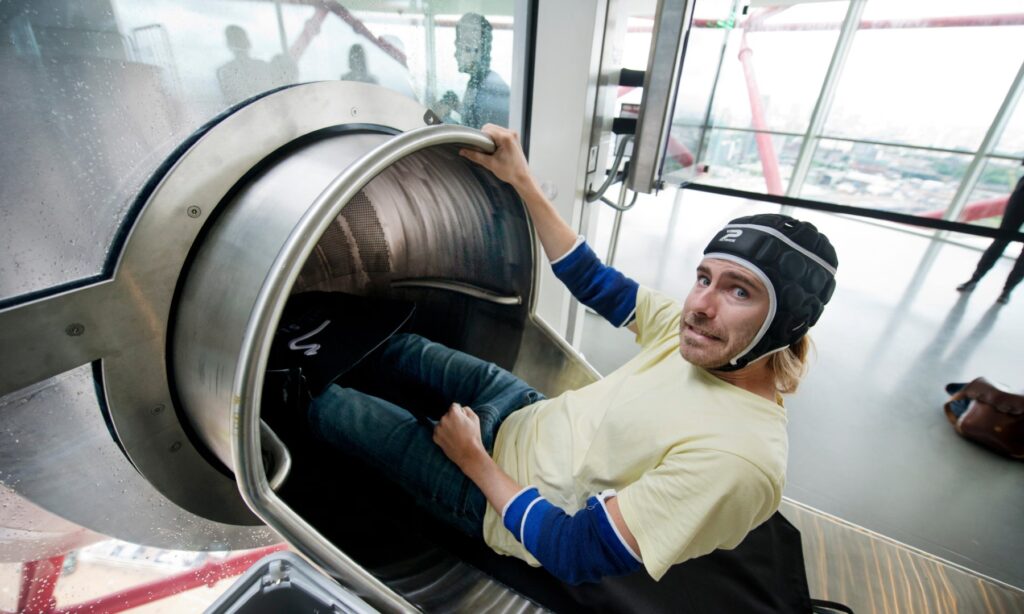
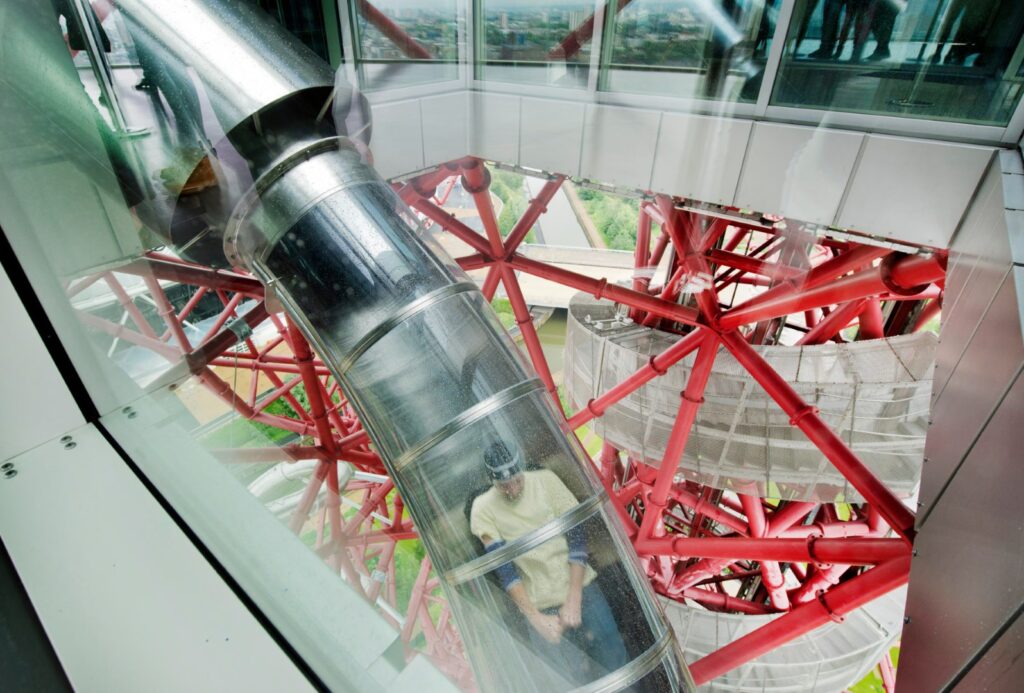
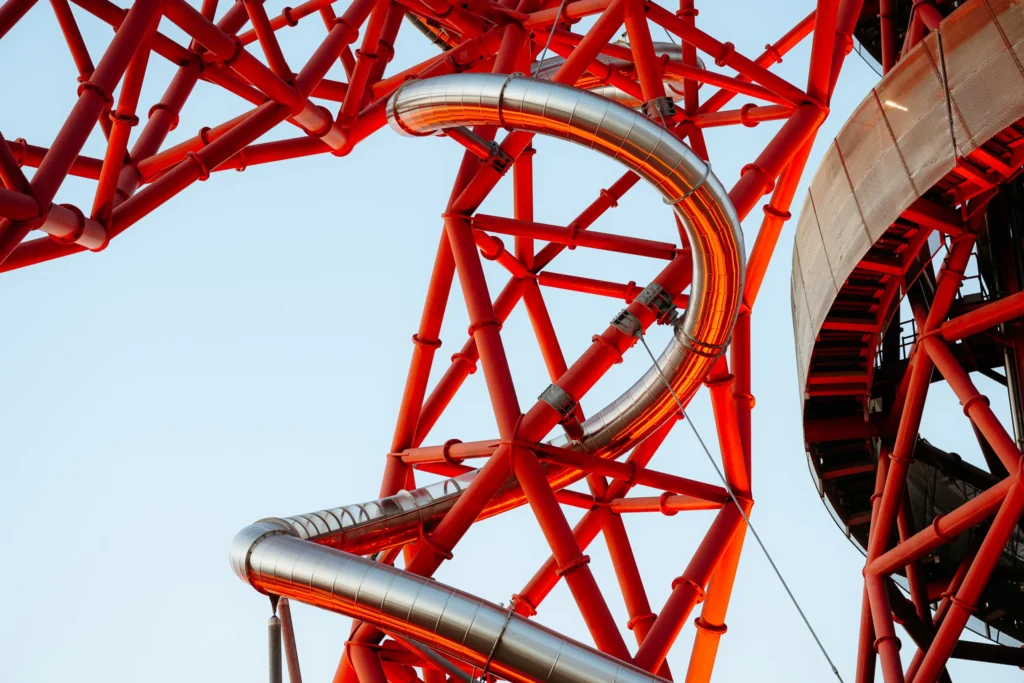
In 2016, the answer arrived. German artist Carsten Höller – invited by Anish Kapoor himself – wrapped a tunnel slide around the outside of the sculpture. It is a collaboration by two artists, which makes it the only installation in Höller’s career built onto someone else’s artwork. The result is called Helix, and it holds two world records: it is the world’s tallest tunnel slide at 76 metres high, and the world’s longest at 178 metres in length.
The slide spirals around the Orbit 12 times on the way down. It includes a tight corkscrew section that Höller named the ‘bettfeder’ – German for ‘bedspring’. Riders hit speeds of up to 15mph during the 40-second descent. It ends with a sudden drop back to earth from what feels like 15 storeys up, and yes, it is as alarming as it sounds.
Here’s the thing: Helix works as art in a way that slides don’t usually manage. Höller has spent decades making large-scale slides as installations – at the Tate Modern, at the Hayward Gallery, across Europe and beyond. The premise is always the same: something that appears familiar and childlike becomes strange and slightly vertiginous when you’re inside it at height. Wrapped around a 114.5-metre sculpture in an Olympic park, the effect is amplified considerably. You notice things differently when you’re moving fast.
Zip World takes over: what the Orbit is now
In September 2024, Welsh adventure company Zip World – famous for its zip lines and underground adventures across North Wales and beyond – took over operations at the Orbit, investing £2.6 million in the site. It became their first London location and their first city-based operation, rebranded as Zip World London at ArcelorMittal Orbit.
The Helix slide remains the centrepiece. The ArcelorMittal Orbit 360 viewing platform – the observation deck at 80 metres up – runs alongside it as a separate experience. Tickets start from £9 for the viewing platform alone and from £17 for the slide. Book in advance; these are timed slots. The views from the upper deck are extraordinary: up to 20 miles on a clear day, covering the Shard, the Gherkin, Big Ben, the BT Tower, Canary Wharf and the O2 Arena. On a good day you can spot five of London’s football grounds. You can also see Alexandra Palace to the north, Wembley to the west, Crystal Palace to the south and Epping Forest to the east.
And there is more coming. Plans for a 440-metre zipline were submitted in October 2025 – approved by both Tower Hamlets and Newham councils – that would see riders launched from the top of the Orbit to a new 38.7-metre return tower, then brought back. If it opens, it will be another first for the park. Zip World estimates it would add 60,000 visitors a year to the attraction’s numbers, which have already passed 1.12 million since the Orbit first opened.
Come to us first (and after)
We’re right here in Queen Elizabeth Olympic Park – a proper bar and restaurant with over 1,000 board games, a five-minute walk from the Orbit. Whether you’re visiting before you head up or coming in to recover after you’ve shot down 178 metres of tunnel slide at 15mph, we’re the obvious stop.
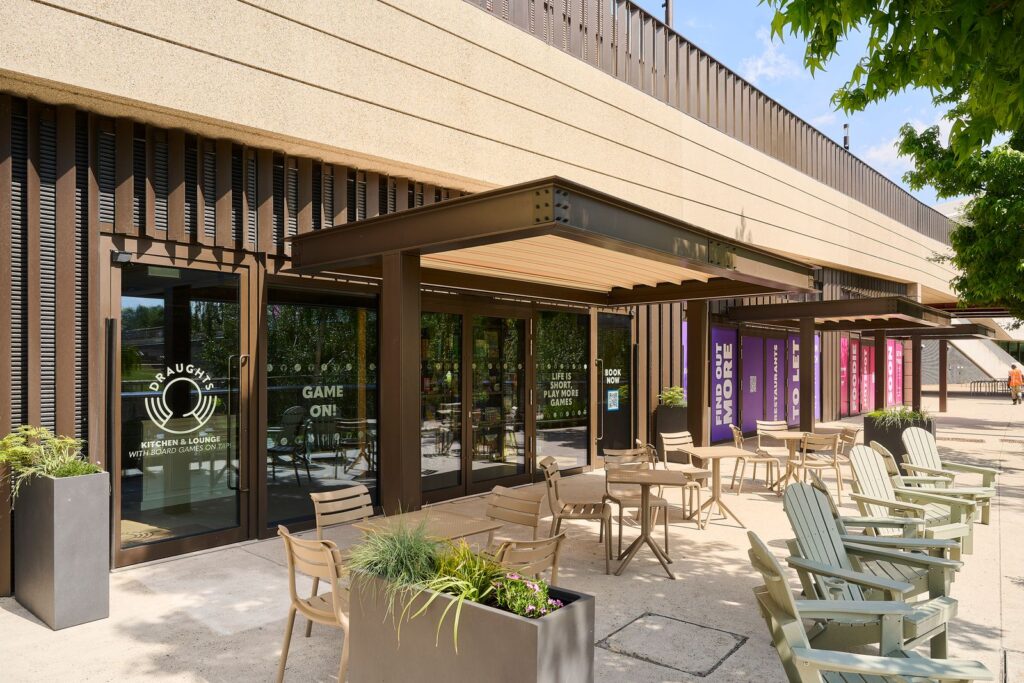
Our address is 5 Aquatics Walk, E20 2AS. You’ll find us inside the park, between the stadium and the waterways. Come in, pick something from the library, order food and drinks, and make a fantastic day of it. We’re not going anywhere.
On food: the Sampler Platter (£35 – corndogs, empanadas, halloumi fries, tortilla chips, hummus, guacamole, the lot) is exactly right for a table settling in after an adventure. So is the Short Rib Birria Tacos (£13.25 – slow-cooked rare breed beef in chilli and lime broth with a consommé dip). On drinks: the Margarita pitcher (£30) has been waiting for this exact situation. Book a table in advance at draughtslondon.com.
While you’re here: something from the library
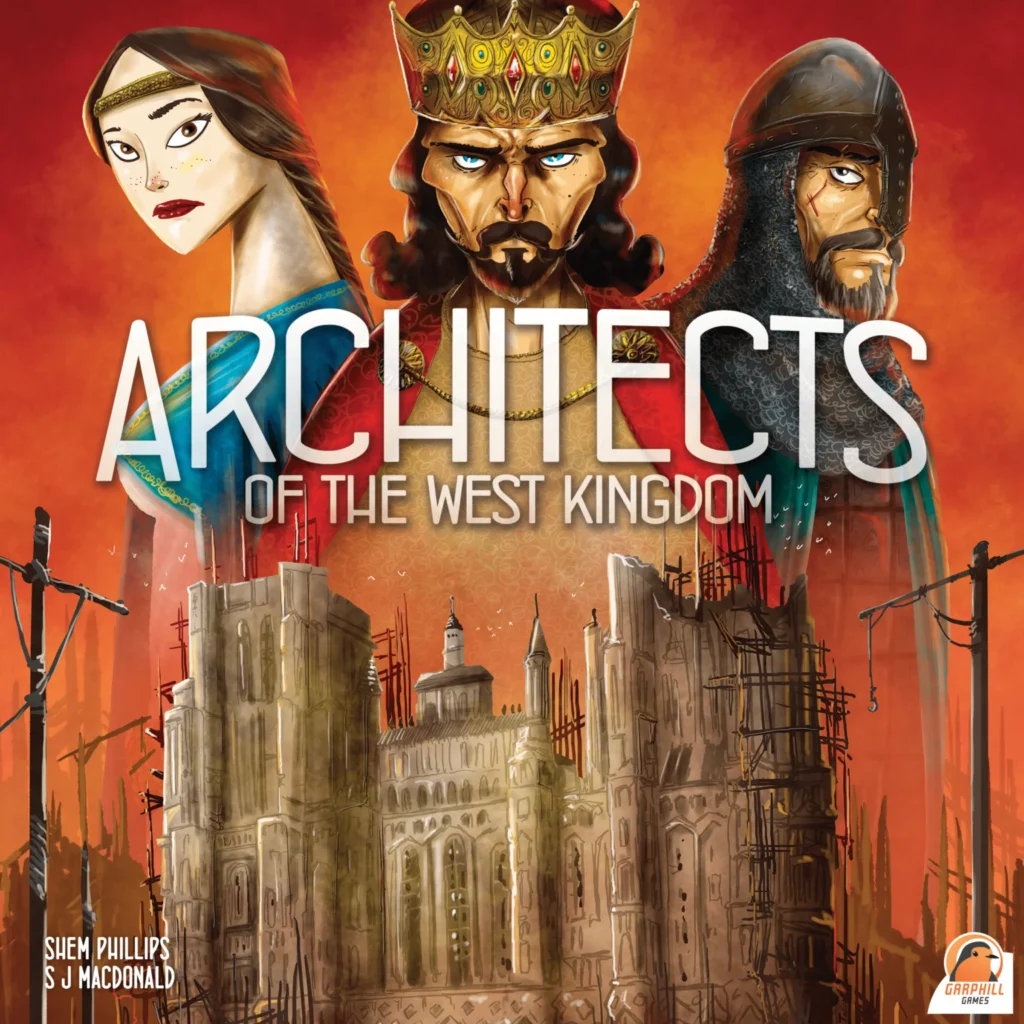
We have over 1,000 games in the library. Given you’ve just spent time at one of the most architecturally ambitious things in east London, we’d suggest something with a bit of scale to match. Architects of the West Kingdom is one – a beautiful strategy game about civic ambition and building something that lasts. Or if you’d rather just decompress after the slide with something daft and fast, any of the party games on the shelves will do. Ask the staff and they’ll find the right thing.
Practical tips before you go
- Book timed slots in advance at zipworld.co.uk/locations/london – the slide and the viewing platform are separate bookings.
- Arrive 30 minutes before your start time. That’s not a suggestion; it’s a requirement to check in.
- The slide has height restrictions (minimum 1.1 metres) and weight restrictions (maximum 130kg). Check the full restrictions list on the Zip World site before visiting with children.
- Stratford station is about a 10-minute walk. The Elizabeth line, Central line, London Overground and National Rail all stop there. Zip World say the Orbit is 7 minutes from St Pancras International.
- The viewing platform experience includes Anish Kapoor’s polished concave mirrors – look into them and your perspective flips. Worth paying attention to.
Frequently Asked Questions
Where is the best place to eat near the ArcelorMittal Orbit?
Draughts is a bar, restaurant and board game café at 5 Aquatics Walk, inside Queen Elizabeth Olympic Park – a five-minute walk from the ArcelorMittal Orbit. We serve a full food menu, cocktails, pitchers and draught beer, and have over 1,000 board games. Book a table in advance at draughtslondon.com.
Where can I eat and drink near the ArcelorMittal Orbit?
Draughts at 5 Aquatics Walk is the closest bar and restaurant to the ArcelorMittal Orbit inside Queen Elizabeth Olympic Park. We’re open daily with a full food and drinks menu. There is also food available at the Zip World on-site bar, and a range of options elsewhere in the park and in Stratford town centre nearby.
What to do near the ArcelorMittal Orbit?
Draughts is a five-minute walk from the Orbit – a bar, restaurant and board game café with over 1,000 games, ideal for making a full day of your visit. The park also contains the London Aquatics Centre, the Lee Valley Velopark, London Stadium (home of West Ham United, capacity 62,500) and the V&A East Storehouse.
What is the ArcelorMittal Orbit?
The ArcelorMittal Orbit is a 114.5-metre sculpture in Queen Elizabeth Olympic Park, Stratford, east London. Designed by sculptor Sir Anish Kapoor and engineer Cecil Balmond, it is the UK’s tallest sculpture and was built to mark the London 2012 Olympic and Paralympic Games. It is now operated by adventure company Zip World as Zip World London.
Who designed the ArcelorMittal Orbit?
The ArcelorMittal Orbit was designed by sculptor Sir Anish Kapoor and structural engineer Cecil Balmond. The project came about after a conversation in a cloakroom at the 2009 World Economic Forum in Davos between then-Mayor of London Boris Johnson and Lakshmi Mittal, chairman and CEO of ArcelorMittal, the world’s largest steel company.
How tall is the ArcelorMittal Orbit?
The ArcelorMittal Orbit stands 114.5 metres tall – making it the UK’s tallest sculpture and 22 metres higher than the Statue of Liberty. The observation deck sits at 80 metres above ground level.
What is the slide at the ArcelorMittal Orbit?
The slide is called Helix and holds two world records: it is the world’s tallest tunnel slide at 76 metres high and the world’s longest at 178 metres. It was created by German artist Carsten Höller at the invitation of Anish Kapoor and opened in summer 2016. It spirals around the Orbit structure 12 times, reaching speeds of up to 15mph during a 40-second descent.
Who created the ArcelorMittal Orbit slide?
The slide – called Helix – is a collaboration between artist Carsten Höller and sculptor Sir Anish Kapoor. It is the only installation in Carsten Höller’s career built onto another artist’s existing artwork. Höller has created large-scale slides at institutions including the Tate Modern and the Hayward Gallery.
How much does it cost to visit the ArcelorMittal Orbit?
The ArcelorMittal Orbit 360 viewing platform costs from £9 (or £7.65 with early bird booking). The Helix slide costs from £17 (or £14.45 with early bird booking). Both are timed slot experiences and must be booked in advance at zipworld.co.uk/locations/london.
Who runs the ArcelorMittal Orbit now?
Since September 2024, the ArcelorMittal Orbit has been operated by Zip World, a Welsh adventure company. Zip World invested £2.6 million into the site, rebranding it as Zip World London. It is their first location in London and in the south of England.
What can you see from the top of the ArcelorMittal Orbit?
On a clear day, the ArcelorMittal Orbit 360 viewing platform offers views of up to 20 miles. Visible landmarks include the Shard, the Gherkin, Big Ben, the BT Tower, Canary Wharf, the O2 Arena and five of London’s football stadiums. You can see Alexandra Palace to the north, Wembley to the west, Crystal Palace transmitter to the south and Epping Forest to the east.
Is there a zipline at the ArcelorMittal Orbit?
A 440-metre zipline has been approved by Tower Hamlets and Newham councils following planning submissions in October 2025. The plans would see riders launched from the top of the Orbit to a new 38.7-metre return tower. As of June 2026, an opening date has not been confirmed. Check arcelormittalorbit.com for updates.
What are the ArcelorMittal Orbit opening times?
Opening times vary seasonally. Check the booking calendar at zipworld.co.uk/locations/london for current times. The site is open year-round except Christmas Day and Boxing Day. Arrive 30 minutes before your booked experience time to check in.
How do I get to the ArcelorMittal Orbit?
The ArcelorMittal Orbit is located in Queen Elizabeth Olympic Park, Stratford, London E20 2AD. Stratford station (served by the Elizabeth line, Central line, London Overground and National Rail) is a 10-minute walk. Zip World state the attraction is 7 minutes from St Pancras International via the Elizabeth line. Driving is possible but public transport is strongly recommended.
How much steel is in the ArcelorMittal Orbit?
The ArcelorMittal Orbit contains enough steel to make 265 double-decker buses. It is assembled from 600 pre-fabricated star-like nodes and held together by 35,000 bolts. Sixty per cent of the steel used is recycled material, including washing machines and used cars.
What to do in Queen Elizabeth Olympic Park after the ArcelorMittal Orbit?
Draughts is a five-minute walk from the Orbit – a bar, restaurant and board game café with over 1,000 games. The park also contains the London Aquatics Centre (designed by Zaha Hadid), the Lee Valley Velopark, the London Stadium (home of West Ham United, capacity 62,500), and the V&A East Storehouse. It is a full day out in itself – check out our guide to family-friendly things to do in Queen Elizabeth Olympic Park if you’re planning a longer visit.