There’s a 7.7km open-air art gallery running through East London, featuring sculptures by some of the most famous artists on the planet, and it’s completely free. No tickets. No queues. No gallery attendants giving you that look when you get too close. Just world-class art sitting by the canal, in the parks and along the waterways between Queen Elizabeth Olympic Park and The O2 in Greenwich.
It’s called The Line, and most Londoners have never heard of it.
If you’re looking for something properly different to do on a bank holiday – something that gets you outdoors, doesn’t cost anything and genuinely surprises you – this is it. The best part, the trail starts right here in Stratford, a few minutes’ walk from Draughts. You can spend the morning walking art, the afternoon playing games, and end the day feeling like you’ve had one of the best days out London has to offer.
What Is The Line?
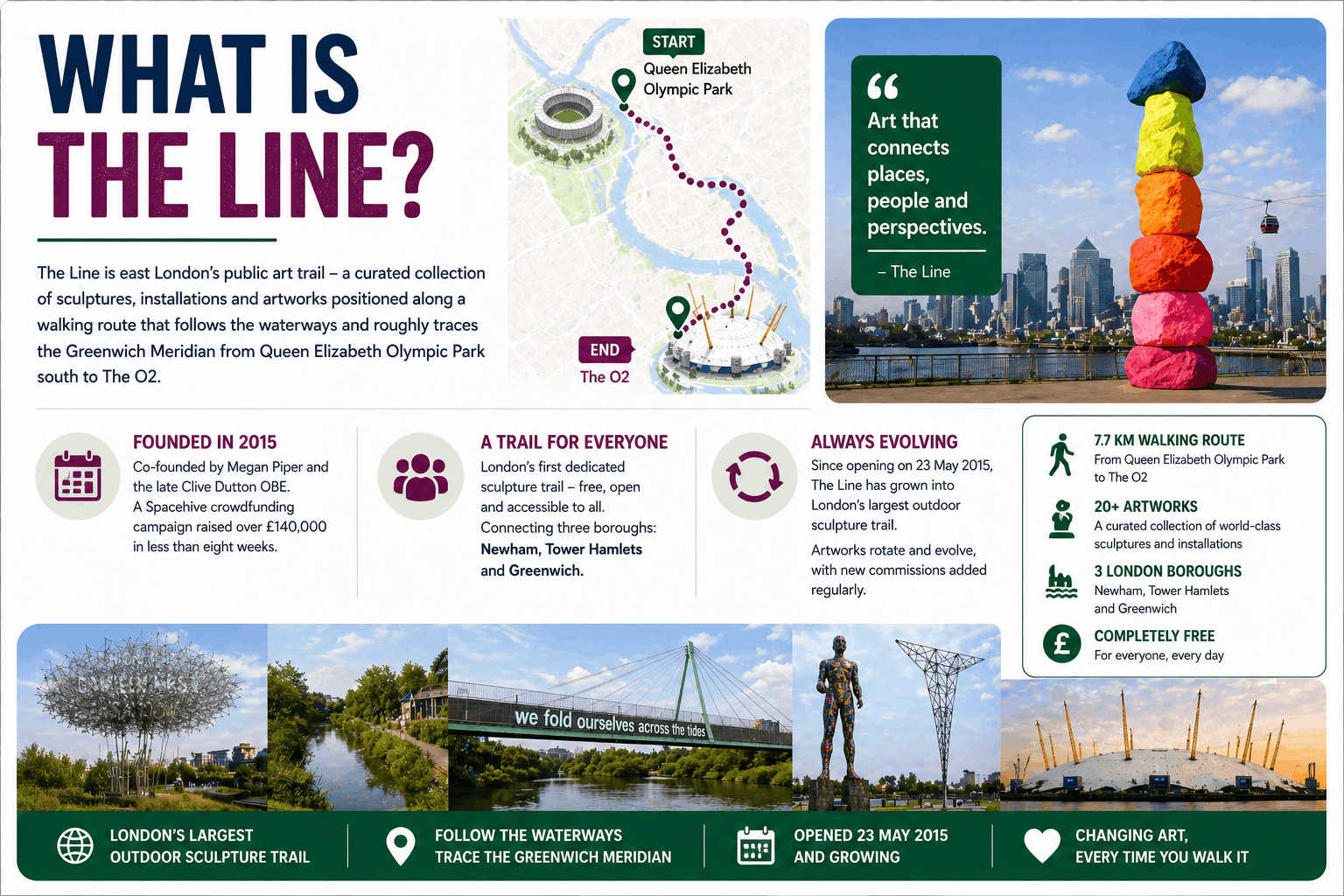
The Line is east London’s public art trail – a curated collection of sculptures, installations and artworks positioned along a walking route that follows the waterways and roughly traces the Greenwich Meridian from Queen Elizabeth Olympic Park south to The O2.
It was co-founded in 2015 by Megan Piper and the late regeneration expert Clive Dutton OBE, after a Spacehive crowdfunding campaign raised over £140,000 in less than eight weeks. The idea was simple but ambitious: create London’s first dedicated sculpture trail, entirely free and accessible to everyone, connecting three London boroughs – Newham, Tower Hamlets and Greenwich – through world-class public art.
Since opening on 23 May 2015, The Line has grown into London’s largest outdoor sculpture trail. The artworks rotate and evolve, with new commissions joining the collection regularly. It’s never the same trail twice, which means even if you’ve walked it before, there’s always a reason to come back.
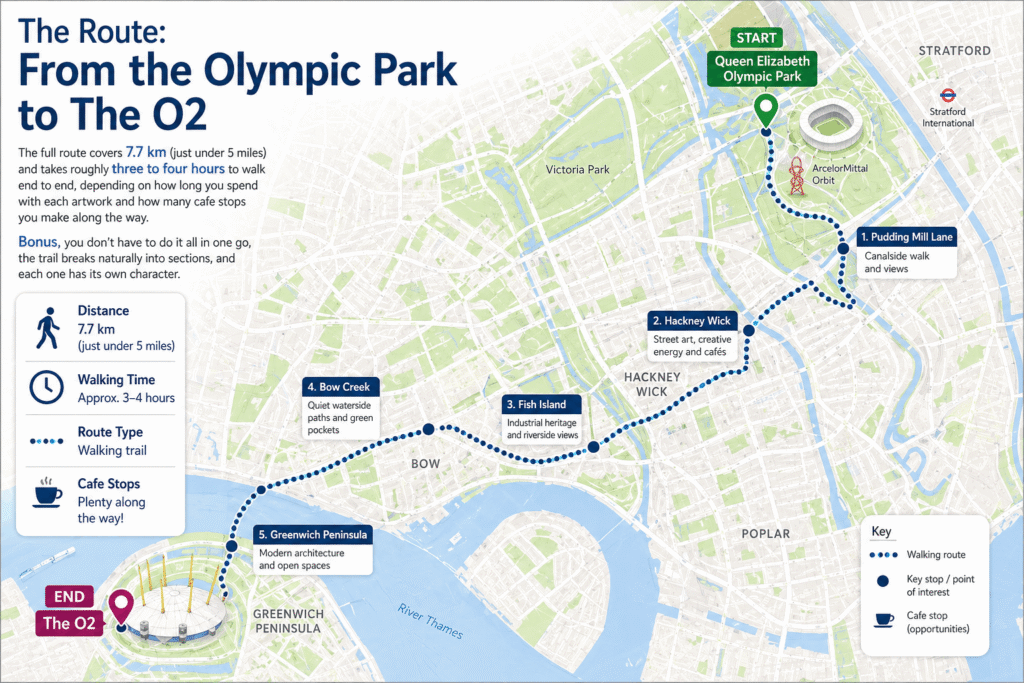
The Route: From the Olympic Park to The O2
The full route covers 7.7 km (just under 5 miles) and takes roughly three to four hours to walk end to end, depending on how long you spend with each artwork and how many cafe stops you make along the way. Bouns, you don’t have to do it all in one go, the trail breaks naturally into sections, and each one has its own character.
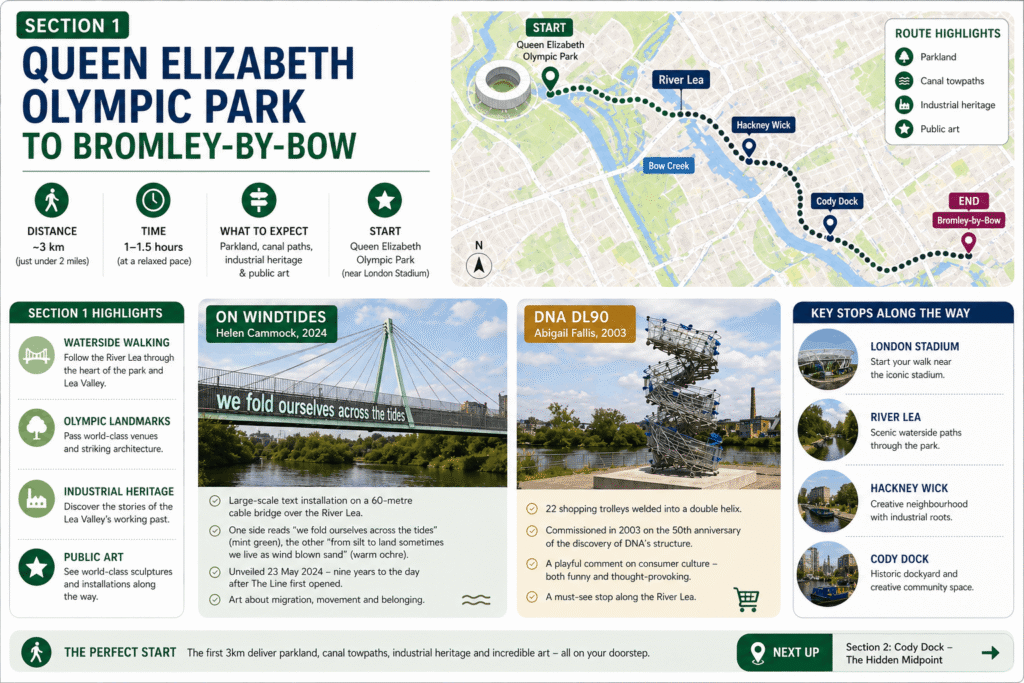
Section 1: Queen Elizabeth Olympic Park to Bromley-by-Bow
This is where it starts, and it’s the section closest to Draughts. The trail picks up near London Stadium and follows the River Lea south through the park. The first 3km take you along the waterway, past the major Olympic venues and into the quieter stretches of the Lea Valley. This section alone is a brilliant bank holiday walk – you get parkland, canal towpaths, industrial heritage and art all in one stretch.
Along this section you’ll find some of the trail’s most striking pieces. Helen Cammock’s On WindTides is one of the newest additions – unveiled on 23 May 2024, exactly nine years to the day after The Line first opened. It’s a large-scale text installation spanning a 60-metre cable bridge just north of Cody Dock, where the bridge crosses the River Lea between Tower Hamlets and Newham. One side reads “we fold ourselves across the tides” in a mint-green powder-coated steel, and the other reads “from silt to land sometimes we live as wind blown sand” in warm ochre. Each letter stands proud from the bridge surface so the sunlight casts shifting shadows throughout the day. Cammock shared the Turner Prize in 2019 (in a historic first, all four nominees were awarded the prize jointly), and this piece was developed through workshops with local community groups – it’s art about migration, movement and what it means to belong to a place.
You’ll also pass Abigail Fallis’s DNA DL90 – 22 shopping trolleys welded into the shape of a double helix, originally commissioned in 2003 on the 50th anniversary of the discovery of DNA’s structure. It’s sitting right there on the River Lea, a playful comment on consumer culture that somehow manages to be both funny and thought-provoking. The kind of thing you stop and photograph, then think about on the bus home.
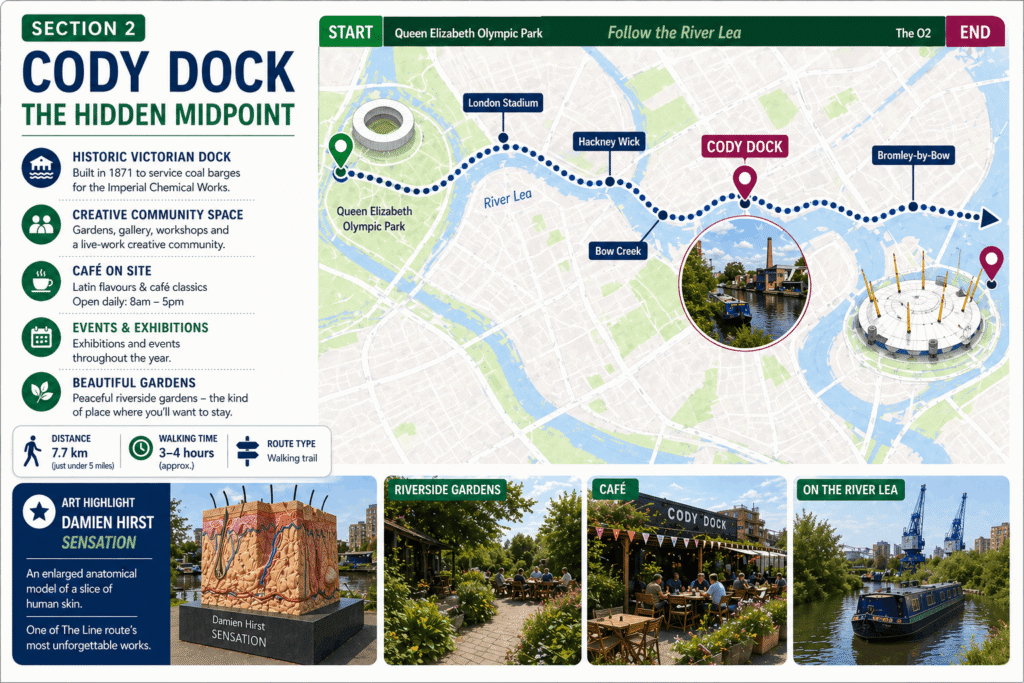
Section 2: Cody Dock – The Hidden Midpoint
If you only walk to one stopping point, make it Cody Dock. This old Victorian dock on the tidal River Lea was built in 1871 to service coal barges for the Imperial Chemical Works. Today, thanks to the Gasworks Dock Partnership community initiative, it’s been transformed into one of east London’s most unexpected creative hubs – a community space with gardens, a gallery, workshops and a brilliant little cafe serving Latin flavours and cafe classics, open daily from 8am to 5pm.
The dock receives tens of thousands of visitors a year and over 2,500 volunteers, and it’s home to a live-work creative community. The gardens are beautiful and peaceful – the kind of place where you sit down for ten minutes and stay for an hour. Cody Dock also hosts exhibitions and events throughout the year, and the venue is on the Line route, so you get the art and the atmosphere in one stop.
Right here at Cody Dock you’ll find Damien Hirst’s Sensation – an enlarged anatomical model of a slice of human skin. It’s one of those works that stops you in your tracks. Love it or hate it, you won’t forget it. And that’s exactly what good public art should do.
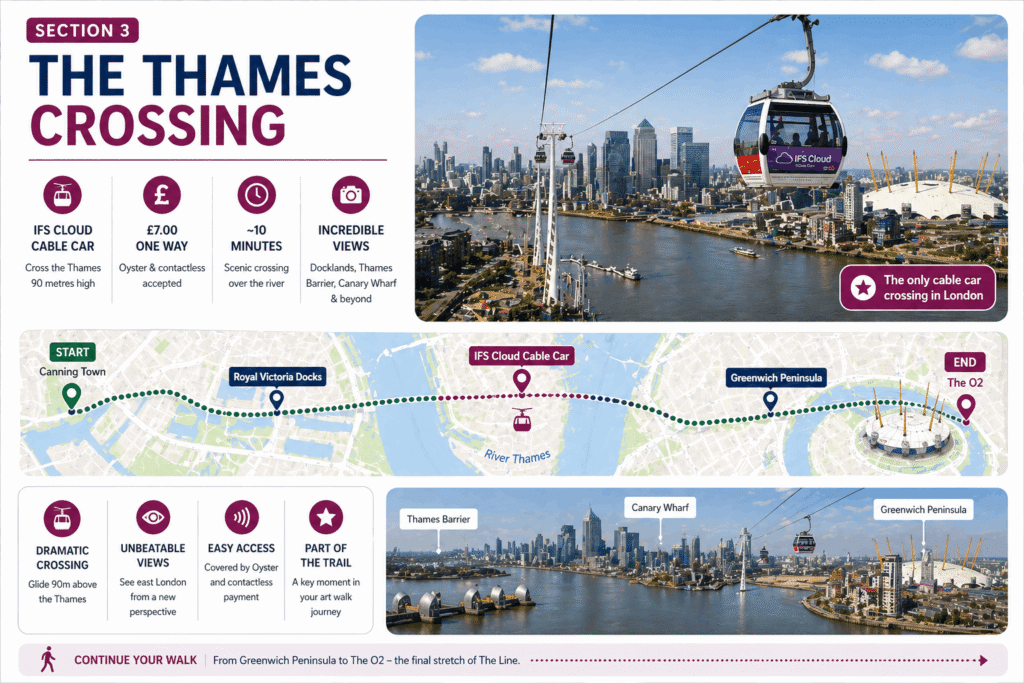
Section 3: The Thames Crossing
Here’s where the route gets properly dramatic. The trail continues south through Canning Town to the Royal Victoria Docks, where you pick up the IFS Cloud Cable Car – the only cable car crossing in London. For 7 pounds one way, you cross the Thames 90 metres above the water, with views of the Docklands, the Thames Barrier, Canary Wharf and the whole east London skyline. On a clear day it’s genuinely breathtaking. The crossing takes about 10 minutes and it’s covered by Oyster and contactless payment.
The cable car isn’t just transport – it’s part of the art trail experience. You’re literally suspended above the river, looking down on the waterways you’ve been walking along, and ahead to the Greenwich Peninsula where the final cluster of sculptures is waiting.
Section 4: Greenwich Peninsula and The O2
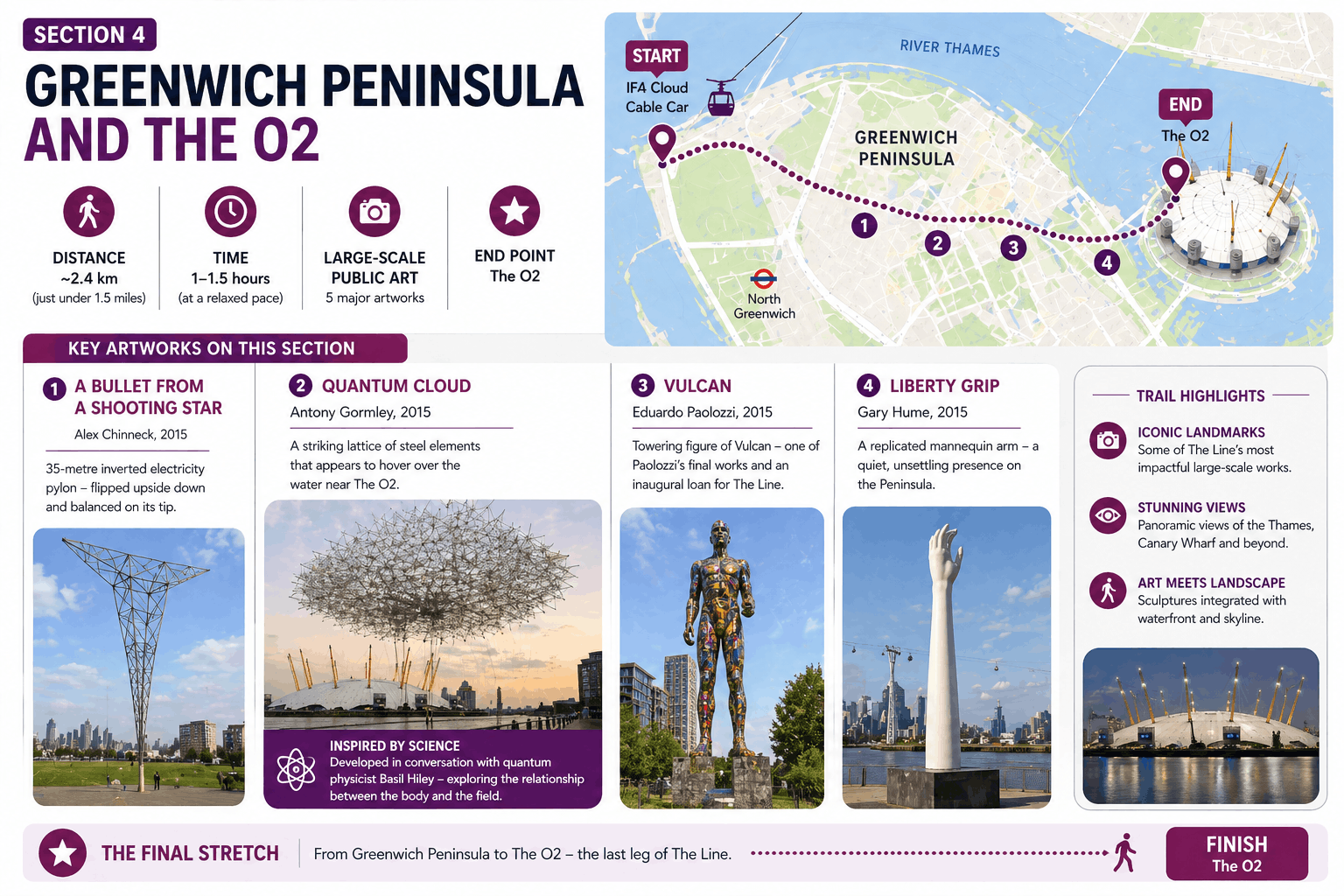
The southern section of the trail clusters around Greenwich Peninsula and features some of The Line’s most impactful large-scale works. Alex Chinneck’s A Bullet from a Shooting Star is a 35-metre inverted electricity pylon – flipped upside down and balanced on its tip. Commissioned in 2015, it’s one of those pieces that makes you stop and stare because your brain can’t quite process what it’s seeing.
Antony Gormley’s Quantum Cloud is the trail’s most famous landmark. Composed of a central group of 325 extended steel sections connected to over 3,500 elements radiating outward, it hovers over the water near The O2 like a figure emerging from – or dissolving into – a cloud of particles. Gormley developed the piece through conversations with quantum physicist Basil Hiley, and it questions whether the body produces the field or the field produces the body. That might sound heady, but when you’re standing underneath it, watching the light pass through the steel lattice, the experience is purely visual and completely absorbing.
Eduardo Paolozzi’s towering figure of Vulcan is another highlight – one of his last works, it was among the inaugural loans when The Line opened in 2015. Gary Hume’s Liberty Grip, a replicated mannequin arm, offers a quieter, more unsettling presence nearby.
The Art: What You’ll Actually See
One of the best things about The Line is the range. This isn’t a trail of one type of art – it’s a deliberately eclectic mix of permanent installations, temporary commissions and existing works that have been drawn together into a single walking experience.
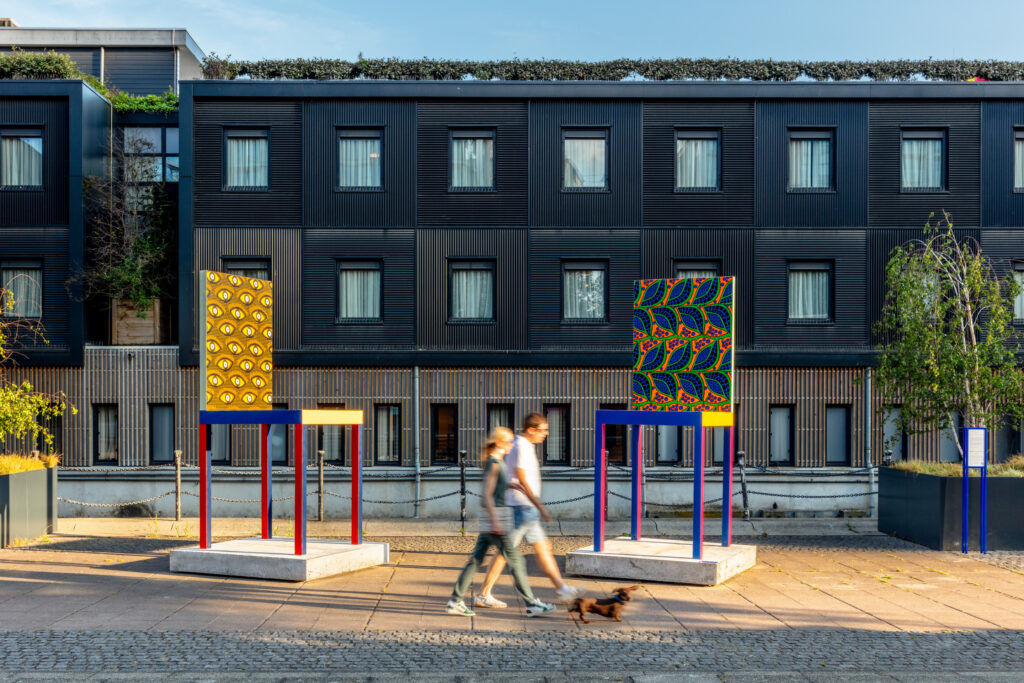
As of 2026, the trail features works by artists including Antony Gormley, Damien Hirst, Helen Cammock, Abigail Fallis, Alex Chinneck, Eduardo Paolozzi, Gary Hume, Eva Rothschild, Larry Achiampong, Madge Gill, Rana Begum and Yinka Ilori. Some are monumental – 35-metre inverted pylons and towering steel sculptures. Others are intimate – text on a bridge, a bench reimagined with portraits of young people from the local community.
Eva Rothschild’s Living Spring is a slender sculpture where patterns of red and green are interrupted by blocks of black – complementary colours that create an almost hypnotic visual rhythm. It’s the kind of piece you might walk past if you weren’t looking, and then can’t stop looking at once you’ve seen it.
The trail also incorporates historical and architectural landmarks along the route. Three Mills Island – with the world’s largest surviving tidal mill, built in 1776 – sits right on the path. Abbey Mills Pumping Station, the spectacular Victorian “Cathedral of Sewage” with its Moorish towers and Byzantine interior, is visible from the route. These aren’t artworks in the traditional sense, but they’re part of the trail’s story about the layers of east London’s history.
The Free Audio Guide: Bill Nighy Walks With You
Here’s something most people don’t know. The Line has a free digital guide on the Bloomberg Connects app (free to download from the App Store or Google Play) that offers three different ways to experience the trail.
You can delve deeper into the art, with audio from the artists themselves talking about their work. You can follow a nature and local history route, learning about the ecology and industrial heritage of the Lea Valley. Or you can turn the walk into a mindfulness and wellbeing experience. And the whole thing is narrated by Bill Nighy. Yes, that Bill Nighy. Walking through east London listening to Bill Nighy talk about sculpture and the River Lea is about as good as a bank holiday gets.
Download the app before you set off – there’s no signal in a few spots along the canal, so it’s worth having the guide loaded up in advance.
Walking Tips: How to Do The Line
Start in Stratford. The northern end of the trail is right here in Queen Elizabeth Olympic Park, which means you can start at Draughts for breakfast and a game, then pick up the trail from London Stadium. Or walk the trail first and finish at Draughts.
You don’t have to walk the whole thing. The Stratford-to-Cody Dock section is about 3 km and takes roughly an hour to 90 minutes. That’s a perfect bank holiday morning walk. Do that section, grab lunch at Cody Dock’s cafe, then head back to Draughts.
Follow the markers. Blue and red vinyl markers on the ground guide you along the route. They’re small but they’re there – keep your eyes down at junctions.
Wear decent shoes. Most of the route is paved or well-maintained towpath, but there are a few rougher sections, especially around the canal edges. Trainers are fine. Heels are not.
Check the-line.org before you go. The website has an interactive map showing every artwork’s current location, plus information about any new commissions or temporary exhibitions. Artworks rotate, so the trail you walked last year might have new pieces this year.
Take the cable car. If you’re doing the full route, budget an extra 7 pounds for the IFS Cloud Cable Car crossing. It’s covered by Oyster and contactless, takes about 10 minutes, and the views are spectacular. If you’ve got kids, they’ll talk about it for weeks.
Bring a portable charger. If you’re using the Bloomberg Connects audio guide on your phone, plus taking photos of every sculpture (you will), your battery won’t last the full route. A small power bank solves the problem.
Board Games That Match the Art Walk Vibe
Back at Draughts after your walk? Here are some games that capture the same spirit of exploration and discovery.
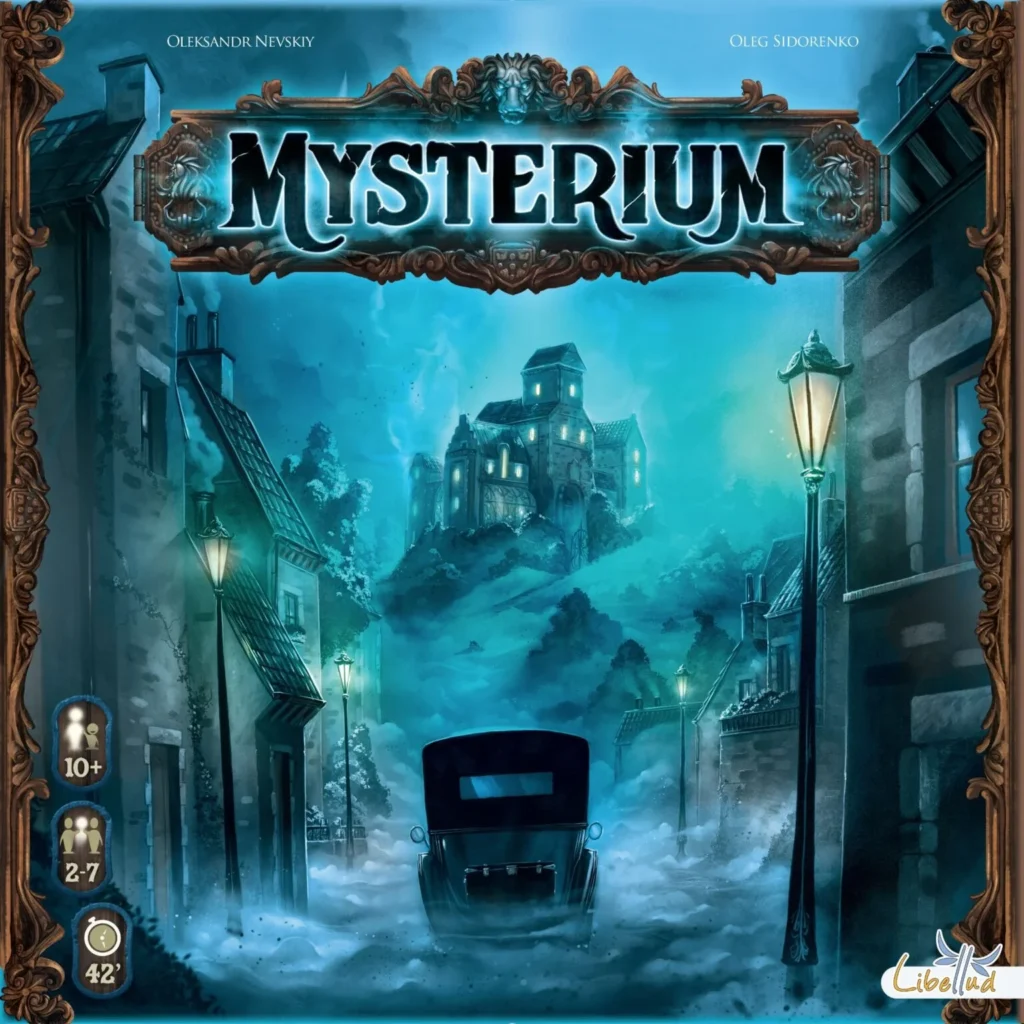
Mysterium is perfect if the art has put you in a visual, interpretive mood. One player sends cryptic visual clues (beautifully illustrated cards that look like abstract paintings) while the others try to decode the meaning. It’s collaborative, atmospheric and exactly the kind of game where you’ll say “that card obviously represents the Damien Hirst” and nobody will agree with you.
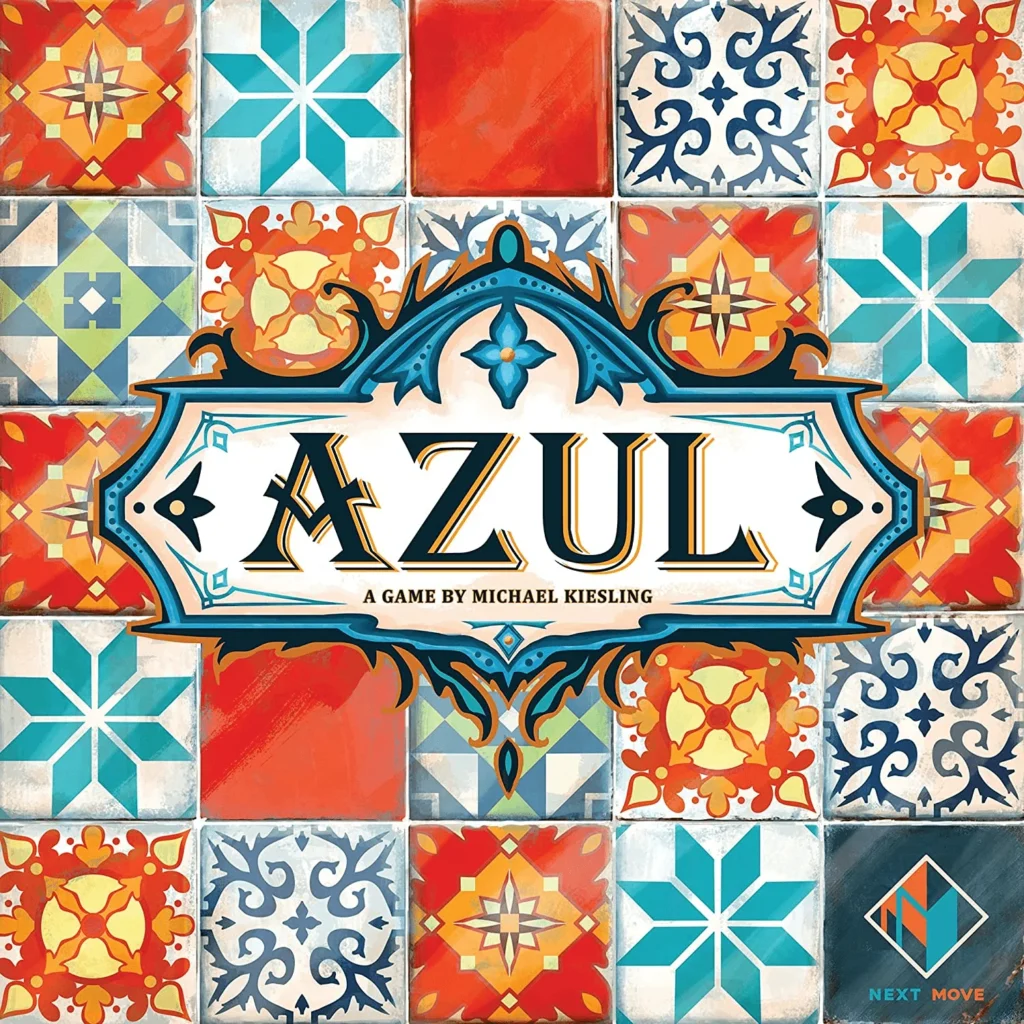
Azul is a tile-laying game inspired by Portuguese ceramic art. It’s visually gorgeous, deeply satisfying to play, and the strategy of building patterns from coloured tiles feels like curating your own small exhibition. Quick to learn, endlessly replayable.
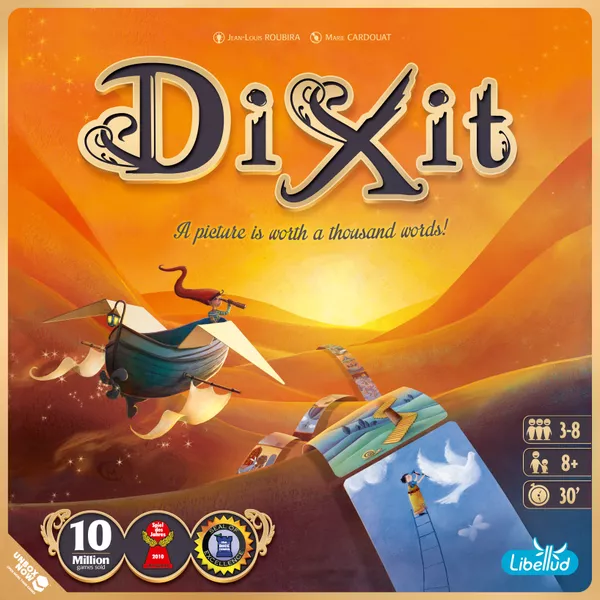
Dixit is another one for the art lovers. Players describe beautifully illustrated cards with a word or phrase, and everyone else tries to guess which card was described. It rewards creativity and lateral thinking – the same muscles you’ve been using all morning looking at sculptures by the canal.
Our staff will point you towards these and plenty more. Just tell them you’ve spent the morning on The Line and want something that keeps the creative energy going.
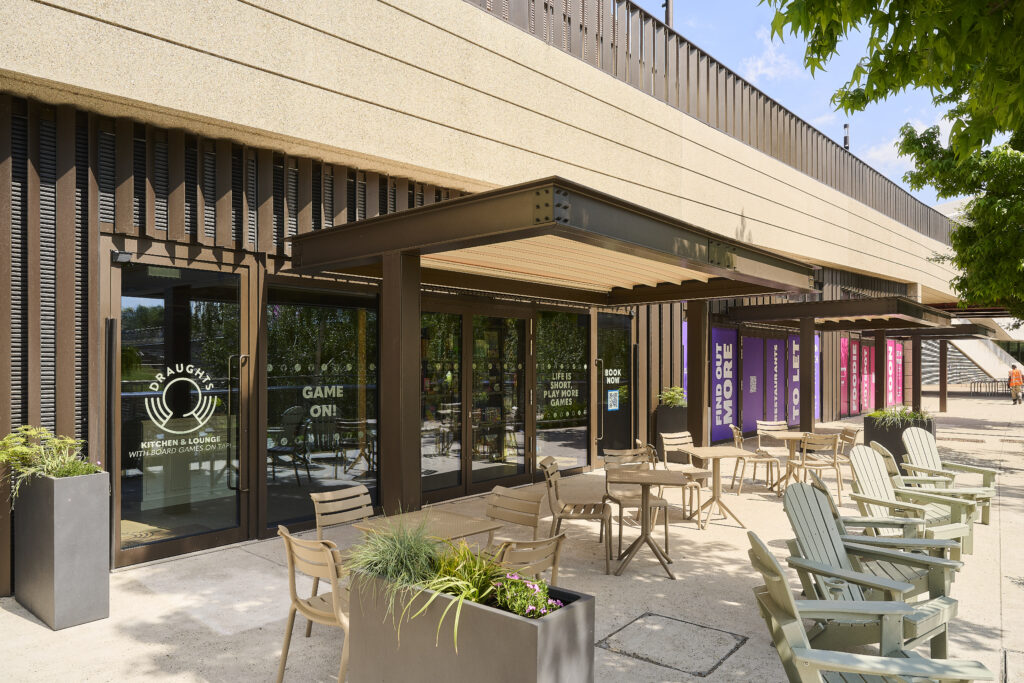
Finish Your Day at Draughts
Here’s our suggestion for the perfect Line day: start at Draughts for a late breakfast, head out to walk the Stratford section of the trail, loop down by the water, then come back to us for the afternoon. By the time you sit down with food, drinks and a game, you’ve had a morning of world-class art, a canal walk, and fresh air – and you’ve still got the whole afternoon ahead of you.
We’re at 5 Aquatics Walk, right inside Queen Elizabeth Olympic Park, a short walk from London Stadium where The Line begins. We’re a bar, board game kitchen and lounge with over 1,000 games, a proper food menu and a well-stocked bar. Whether there’s two of you or ten of you, we’ll sort out the perfect game in about thirty seconds.
Book a table at draughtslondon.com – bank holidays fill up fast, and if you’re planning around a morning art walk, you’ll want a table waiting for you when you get back.

Frequently Asked Questions
What is The Line art trail in London?
The Line is east London’s free public art trail – a 7.7-km walking route from Queen Elizabeth Olympic Park in Stratford to The O2 in Greenwich, following the waterways and roughly tracing the Greenwich Meridian. Founded in 2015 by Megan Piper and Clive Dutton OBE, it features sculptures and installations by internationally acclaimed artists including Antony Gormley, Damien Hirst, Helen Cammock and Alex Chinneck. It’s completely free, open-air and self-guided.
How long does it take to walk The Line?
Walking the full 7.7-kilometre route takes approximately three to four hours, depending on how long you spend with each artwork and how many stops you make. You don’t have to do it all in one go – the Stratford-to-Cody Dock section is about 3 kilometres and takes roughly 60 to 90 minutes, making it a perfect bank holiday morning walk.
Where does The Line start?
The northern end of The Line starts at Queen Elizabeth Olympic Park near London Stadium in Stratford. From there, it follows the River Lea south through Bromley-by-Bow and Canning Town, crosses the Thames via the IFS Cloud Cable Car, and ends at The O2 on Greenwich Peninsula. You can walk it in either direction.
Is The Line art trail free?
Yes, completely free. There’s no charge to walk the trail or view any of the artworks. The only cost is the IFS Cloud Cable Car crossing the Thames (7 pounds one way, covered by Oyster and contactless), which is optional – you can also take the Jubilee Line between Canning Town and North Greenwich instead.
What sculptures are on The Line?
As of 2026, The Line features works by Antony Gormley (Quantum Cloud), Damien Hirst (Sensation), Helen Cammock (On WindTides), Abigail Fallis (DNA DL90 – 22 shopping trolleys in a double helix), Alex Chinneck (A Bullet from a Shooting Star – a 35-metre inverted pylon), Eduardo Paolozzi (Vulcan), Eva Rothschild (Living Spring), Gary Hume (Liberty Grip), and others. The collection rotates, with new commissions added regularly.
Is there an audio guide for The Line?
Yes – The Line has a free digital guide on the Bloomberg Connects app, available from the App Store and Google Play. It offers three ways to experience the trail: an art-focused guide with audio from the artists, a nature and local history route, and a mindfulness and wellbeing experience. The guide is narrated by Bill Nighy. Download it before you set off, as phone signal can be patchy along parts of the canal.
What is Cody Dock?
Cody Dock is a community creative hub on the tidal River Lea, roughly midway along The Line. Originally built in 1871 to service coal barges, it’s been regenerated by the Gasworks Dock Partnership into a space with gardens, a gallery, workshops and a cafe serving Latin-inspired food and cafe classics (open daily 8am to 5pm). It receives tens of thousands of visitors a year and is one of the best stopping points on The Line.
Can I cycle The Line?
Much of The Line follows canal towpaths and parkland routes that are suitable for cycling, but some sections are pedestrian-only. For the best experience, walking is recommended – it’s hard to appreciate the artworks at cycling speed. If you want to cycle part of the route, you can hire bikes from The View Tube on the Greenway near London Stadium.
What is Antony Gormley’s Quantum Cloud?
Quantum Cloud is a monumental sculpture near The O2 on Greenwich Peninsula, composed of 325 central steel sections connected to over 3,500 elements radiating outward. It creates the impression of a human figure emerging from – or dissolving into – a cloud of particles. Gormley developed the piece through conversations with quantum physicist Basil Hiley. It’s one of the most recognisable landmarks in east London and a highlight of The Line.
Where to eat near The Line art trail in Stratford?
Draughts at 5 Aquatics Walk is right inside Queen Elizabeth Olympic Park, where The Line begins. We’re a bar, board game kitchen and lounge with a full food menu, a well-stocked bar and over 1,000 board games – perfect for refuelling after a morning on the trail. Cody Dock cafe is another great option at the midpoint of the route. Book Draughts at draughtslondon.com.
What is the IFS Cloud Cable Car?
The IFS Cloud Cable Car (formerly the Emirates Air Line) crosses the Thames between the Royal Victoria Docks and Greenwich Peninsula. It’s London’s only cable car, reaching 90m above the water with panoramic views of the Docklands, Canary Wharf and the Thames Barrier. A single crossing costs 7 pounds and takes about 10 minutes. It’s part of The Line route and covered by Oyster and contactless payment.
Is The Line suitable for children?
Yes – The Line is a fantastic family walk. Children love spotting the sculptures along the route, especially Abigail Fallis’s shopping trolley DNA helix and Alex Chinneck’s upside-down pylon. The Bloomberg Connects app makes it interactive, and the route passes several playgrounds and green spaces in Queen Elizabeth Olympic Park. The Cody Dock midpoint has gardens and a cafe. Finish at Draughts for family-friendly board games.
What are the best things to do near Queen Elizabeth Olympic Park?
Walking The Line art trail is one of the best free activities starting from the park. Other highlights include Three Mills Island (the world’s largest surviving tidal mill), the Greenway walking and cycling path, Hackney Wick’s creative quarter, Tumbling Bay playground and Timber Lodge cafe. Draughts at 5 Aquatics Walk inside the park is a bar, board game kitchen and lounge with over 1,000 games – book at draughtslondon.com.
When was The Line art trail created?
The Line was co-founded by Megan Piper and Clive Dutton OBE and opened on 23 May 2015, following a Spacehive crowdfunding campaign that raised over 140,000 pounds in less than eight weeks. It was London’s first dedicated public sculpture trail. The collection has grown and evolved continuously since then, with new commissions and artworks added regularly. As of 2026, it remains free and open to the public year-round.