
Picture an apple.
Whatever you just imagined, someone else at your table imagined something different. Maybe yours was the sharp electric green of a Granny Smith. Maybe theirs was deep glossy red. Neither of you is wrong, and neither of you knew until now that you disagreed.
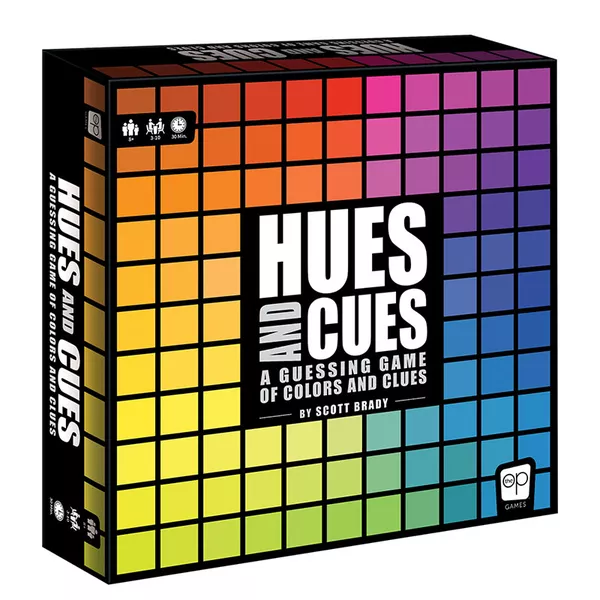
Hues and Cues is built entirely on that gap. One player has to guide everyone else to one exact shade on a board of 480 colours, using one word. Not “blue” – that’s banned. Something that puts the right blue in everyone’s head simultaneously.
It turns out this is much harder than it sounds, and much funnier.
What Is Hues and Cues?
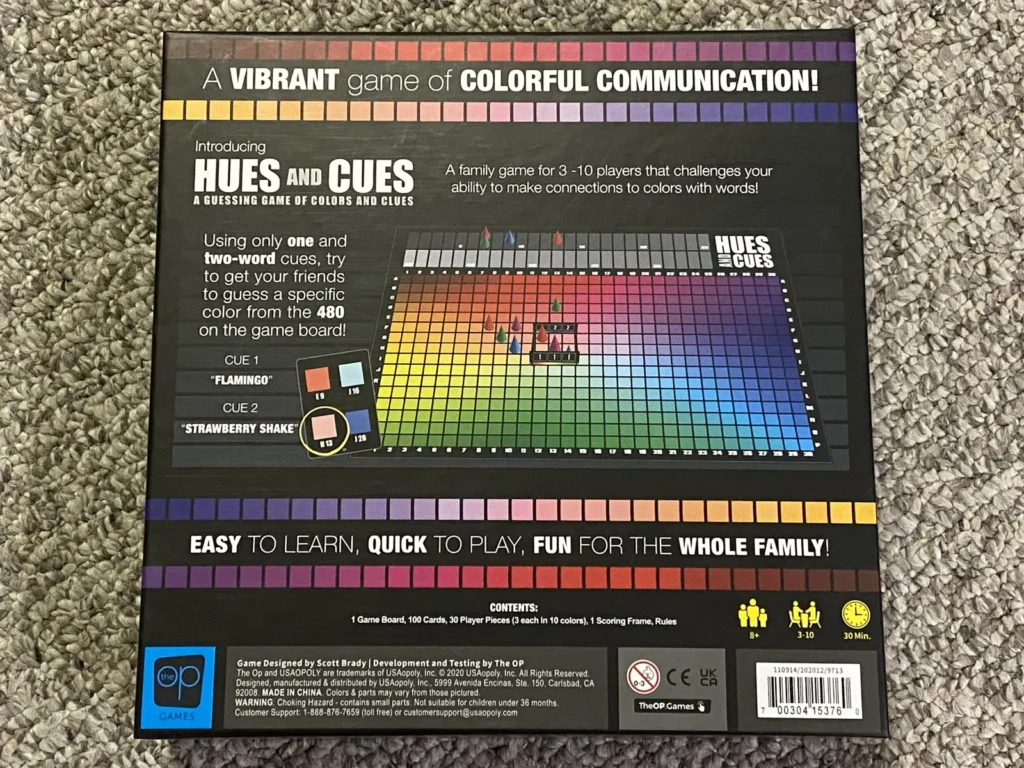
A colour-guessing party game, designed by Scott Brady and published by The Op Games in 2020. Three to ten players, about 30 minutes, ages 8 and up.
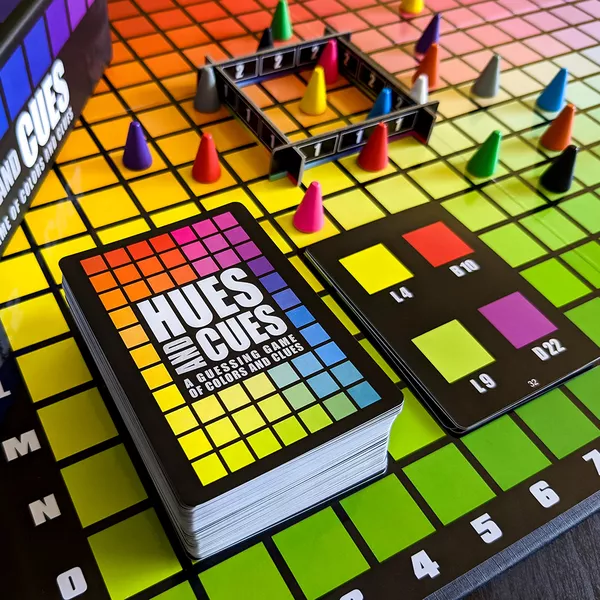
The board is the star. It’s a big grid of 480 colour swatches covering every gradation you can think of – the golden-orange of a late sunset, the murky green-grey of the Thames at low tide, and about 478 other things. People lean over it before anyone’s even explained the rules.
One player is the Cue Giver. They draw a card showing a specific colour and have to talk everyone else into finding it. Everyone places a marker. Closest wins the most points. The Cue Giver scores based on how many people they got near the target. Next round, someone else has a go.
That’s the whole game. It’s what happens in between that makes it worth playing.
Setting Up
Unfold the board and put it somewhere everyone can see properly – it’s big and people will be leaning across it constantly, so a decent-sized table matters more than usual here.
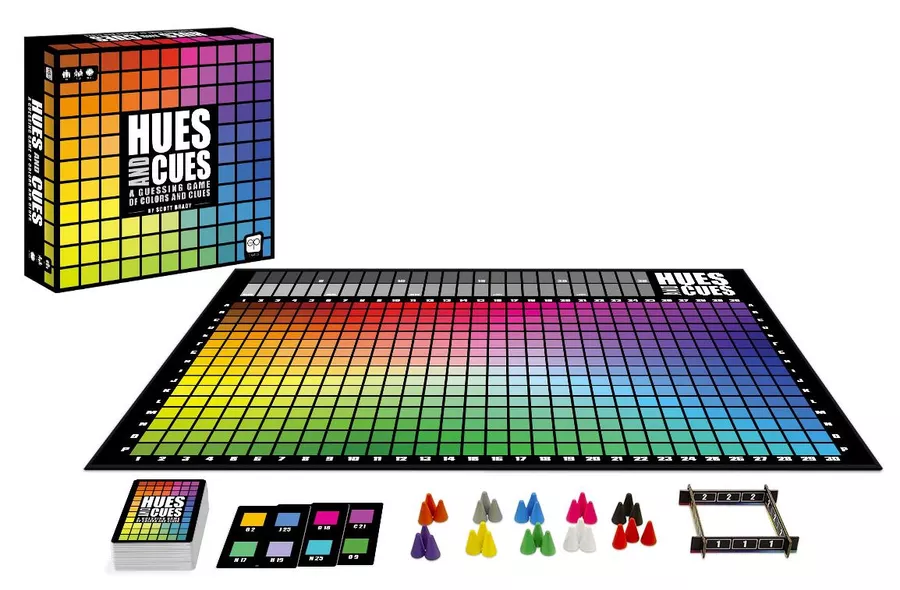
Shuffle the colour cards into a face-down pile. Give everyone two cone markers in their colour. Pick who starts. Done.
Playing a Round
The Cue Giver draws a card. It shows a colour and its coordinates on the board, like a map reference. Only they see it.
They then get two clues to work with, and the two clues do very different jobs.
The One-Word Clue
One word. That’s it. No colour names – you can’t just say “teal” and call it a day. No gestures, no follow-ups, no “well what I meant was”.
Everyone except the Cue Giver puts down a cone, all at the same time. Simultaneous placement matters: you’re guessing against your own eye, not copying whoever moved first.
“Lavender.” “Rust.” “Midnight.” “Custard.” Watching where the cones land after a single word is the best part of the game. Sometimes there’s eerie consensus. Sometimes it looks like someone sneezed on the board.
The Two-Word Clue
Now the Cue Giver gives a second clue, two words this time. Refine, pivot, clarify, start again – up to them.
Anyone who hasn’t placed their second cone does it now. And crucially, anyone who already placed one can move it.
This is where the game gets you. You committed to dusty rose. Now they’ve said “terracotta pot”. Do you shift? Do you trust your first instinct? Everyone’s doing this calculation at once and you can watch it happen across the table.
The Reveal and Scoring
The Cue Giver flips the card. There’s always a beat of silence before it lands, and then either groaning, laughing, or that specific noise people make when something clicks.
Rings go around the target colour to mark the scoring zones. Land directly on it and you get 3 points. Inner ring, 2. Outer ring, 1. Outside that, nothing.
The Cue Giver scores differently – 1 point for every player who landed anywhere in the rings. Which creates the tension that makes the whole thing work. Be too vague and everyone scatters and you get nothing. Be brilliantly precise and everyone lands close and you clean up. Your interests and theirs are aligned, which is unusual and rather nice.
Everyone gets an equal number of turns as Cue Giver. Most points wins.
How to Give Better Cues
The best Cue Givers aren’t the ones with the biggest vocabulary. They’re the ones who can predict what a word does inside their friends’ heads.
Know your table. “Avocado” means something entirely different to someone who’s lived in California than to someone whose parents had an avocado bathroom suite in 1974. Both mental images are real. They’re also about four inches apart on the board.
Concrete beats abstract, almost always. Objects with a colour most people agree on – flamingo, denim, mustard, moss – are your best tools. Abstract concepts scatter people.
Cultural references are a gamble. “Tardis” for a specific blue is perfect with the right crowd and useless with the wrong one. Save them for when you know the room.
And don’t get clever with the second clue. There’s a real temptation to come at it from a completely new angle, but “ocean” followed by “tropical water” does a clean job. “Ocean” followed by “frozen tundra” just makes everyone doubt everything, even if the shade you want genuinely is polar grey-blue.
How to Guess Better
Trust your first instinct more than you want to. The two-word clue tempts everyone into wholesale relocation across the board, when a shift of two or three swatches is usually the right move.
Build a model of the Cue Giver. A few rounds in, you’ll know whether they’re a literal thinker or a pop culture person, whether they go narrow or broad. That knowledge compounds and it’s worth more than anything else in the game.
Watch what everyone else does, but don’t follow them. Five cones in the same area might mean consensus. It might also mean five people made the same wrong assumption. The points are individual.
And always ask what they were thinking after the reveal. “I said ‘morning’ because I meant the sky about twenty minutes after sunrise in October.” That conversation is the actual game. The points are just an excuse.
Why It Works So Well With a Group
Most party games have a ceiling you hit quickly. This one doesn’t, because there’s nothing to be good at in the traditional sense – no vocabulary advantage, no trivia knowledge, no insider references that shut people out. It rewards paying attention and being able to think from someone else’s perspective, which is a rarer skill than it sounds.
It works at eight years old and it works at a table of adults who’d normally roll their eyes at a party game. Thirty minutes means you can play a full game between rounds without it becoming a commitment.
But the real reason it works is the conversation. When someone’s cone is nowhere near the target, everyone wants to know why, and the answer is always interesting. You end up talking about memory and perception and the weird private ways people connect words to colours. You learn things about your friends.
With a drink in hand the arguments get considerably better, and because there’s no bluffing, no elimination and no rules to keep track of, it holds up as the evening goes on.
It’s Hues and Cues, Not Hues and Clues
Quick one, because loads of people search for it this way: the game is Hues and Cues. “Clues” is the more obvious rhyme and it’s an extremely common mix-up, so if you got here searching for Hues and Clues, you’re in the right place. Same game. The “cues” are the prompts you give to steer people across the board.
Come and Play It at Draughts Waterloo
Hues and Cues is in the library at Draughts Waterloo – and it’s Waterloo only, not Stratford, so worth knowing before you travel.
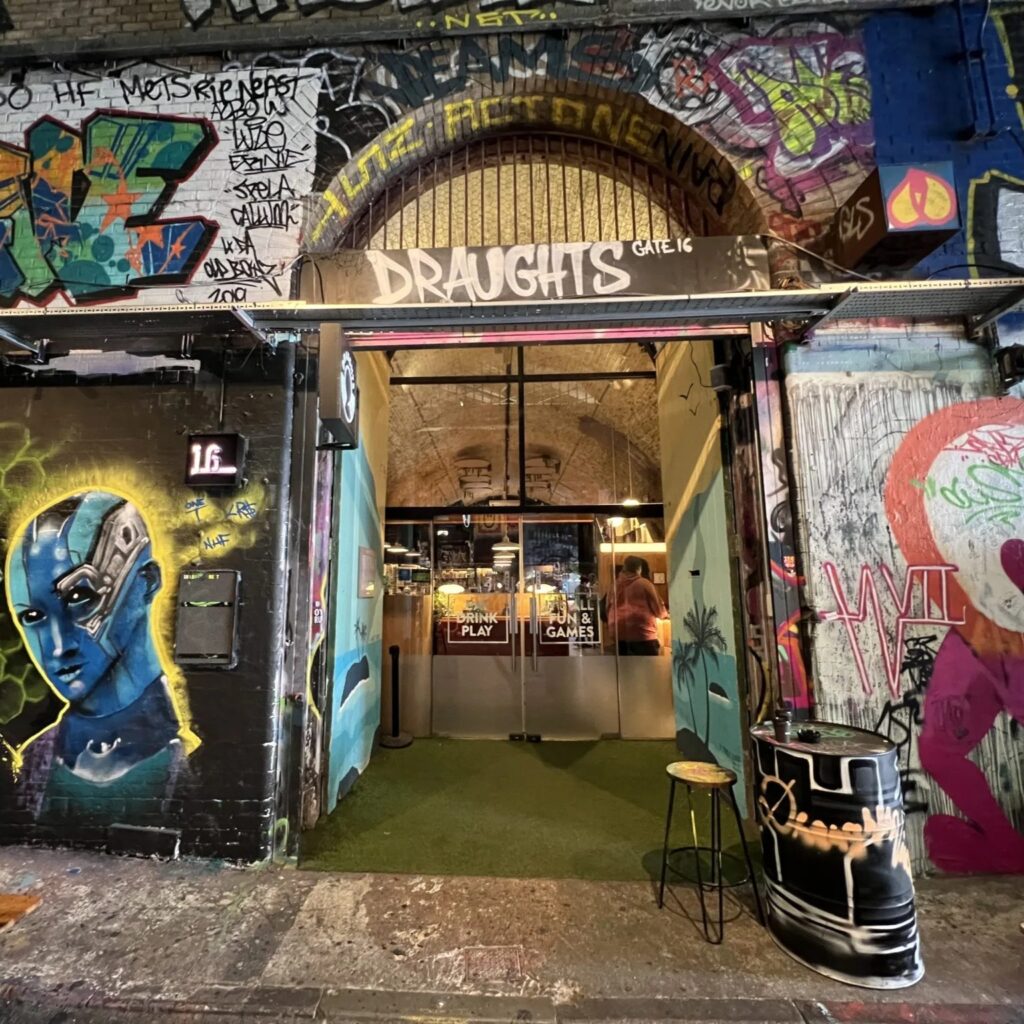
We’re at Arch 16, Leake Street, SE1 7NN, in the railway arches inside the graffiti tunnel under the station. Bar, full kitchen, and over 1,000 games.
This one’s ideal for a group of friends or a work social – anyone who fancies spending an evening arguing about what shade of blue “horizon” is supposed to be. Come for dinner or just drinks, ask at the bar and we’ll set you up.
Book ahead if you can, particularly for a bigger group. draughtslondon.com
Frequently Asked Questions About Hues and Cues
What is Hues and Cues?
Hues and Cues is a colour-guessing party game designed by Scott Brady and published by The Op Games in 2020. Players take turns as the Cue Giver, using one-word and two-word clues to guide everyone else towards a specific colour on a board of 480 swatches. It plays 3 to 10 people and takes around 30 minutes.
How do you play Hues and Cues?
Each round one player draws a card showing a secret target colour and gives a one-word clue. Everyone else places a cone marker on the colour they think matches. The Cue Giver then gives a two-word clue, and players place their second cone or move their first. The target is then revealed – 3 points for landing on it, 2 for the inner ring, 1 for the outer ring. The Cue Giver gets 1 point for every cone that lands in a scoring ring.
How many players does Hues and Cues need?
Three to ten. It works at three but it’s much better with more – more cones means more revealing data about how differently everyone read the same word, and the post-reveal arguments get much better. Six to eight is the sweet spot.
How does scoring work in Hues and Cues?
Landing directly on the target colour scores 3 points. The inner ring around it scores 2. The outer ring scores 1. Anything further out scores nothing. The Cue Giver separately earns 1 point for each player who landed anywhere in either ring, so a good clue pays them as well as everyone else.
How long does Hues and Cues take to play?
About 30 minutes, and that’s an honest estimate – it moves quickly. A full table of ten who like to deliberate can push it a bit longer, but it rarely drags.
What age is Hues and Cues suitable for?
Eight and up, and that’s fair. The concept is immediately graspable and there’s no reading or vocabulary barrier. It genuinely works across generations, though it gets sharper and funnier with adults who have more references to draw on.
What is the difference between Hues and Cues and Hues and Clues?
There isn’t one – they’re the same game. “Hues and Clues” is a very common misspelling. The actual name is Hues and Cues, where “cues” means the prompts the Cue Giver gives to steer players across the board.
Who designed Hues and Cues?
Scott Brady designed it, and The Op Games (also known as USAopoly) published it in 2020. The Op are best known for licensed versions of classic games, but they also produce originals like this one.
What makes a good cue in Hues and Cues?
Specificity plus broad recognisability. You want a word that puts the same colour in most people’s heads at once. Concrete objects with predictable colours work best – flamingo, denim, terracotta, moss. The skill is in the balance: too vague and the table scatters, too niche and only some people follow you. The two-word clue is your chance to correct course.
What are some examples of good one-word cues in Hues and Cues?
Reliable ones include flamingo (vivid warm pink), denim (mid blue), mustard (warm golden yellow), moss (dark earthy green), slate (muted grey-blue) and terracotta (warm red-orange). The best cues are things where nearly everyone pictures the same shade – avoid anything where the association is personal or ambiguous.
Is Hues and Cues good for beginners?
It’s one of the most accessible games there is. No complicated rules, no specialist knowledge, and the concept explains itself in about twenty seconds. It’s a brilliant choice for people who don’t normally play board games.
Can you play Hues and Cues with 2 players?
The rules need a minimum of three, and with good reason. At two players the Cue Giver barely gets any feedback and you lose the whole point of the game, which is seeing how differently several people read the same clue. If you’re a pair, ask us for a two-player recommendation instead.
Can you play Hues and Cues at Draughts?
Yes – it’s in the library at Draughts Waterloo (Arch 16, Leake Street, SE1 7NN). Note that it’s Waterloo only, not Stratford. Book ahead at draughtslondon.com, especially for a group.
Is Hues and Cues a good party game?
One of the best. Fast to learn, quick to play, no knowledge barrier, and a reliable supply of moments where “twilight” sends half the table to purple and the other half to navy. It’s particularly good with drinks because the arguments get better as the evening goes on. For four to eight people it’s hard to beat.