Seventy-five people crammed into a village. One of them is a demon. Most of them are lying. And somehow, it’s your job to figure out which is which.
Blood on the Clocktower is already one of the most talked-about social deduction games on the planet – and if you’ve found yourself Googling “blood on the clocktower roles” at 11pm the night before a game, you’re in very good company. The genius of Trouble Brewing, the base edition, is that every character is doing something different. Understanding what each role actually does is the difference between a confusing first night and a properly brilliant game.
So here it is – every role in Trouble Brewing, explained clearly. Whether you’re a first-timer trying to understand the rulebook or a veteran brushing up before a session, this is the guide you need.
A Quick Note on How It Works
Before we dive in: every player in Blood on the Clocktower has a character token in secret. Good team roles (Townsfolk and Outsiders) are trying to identify and eliminate the Demon by day. Evil team roles (Minions and the Demon) are trying to survive until only three players remain, at which point the Demon wins by default.
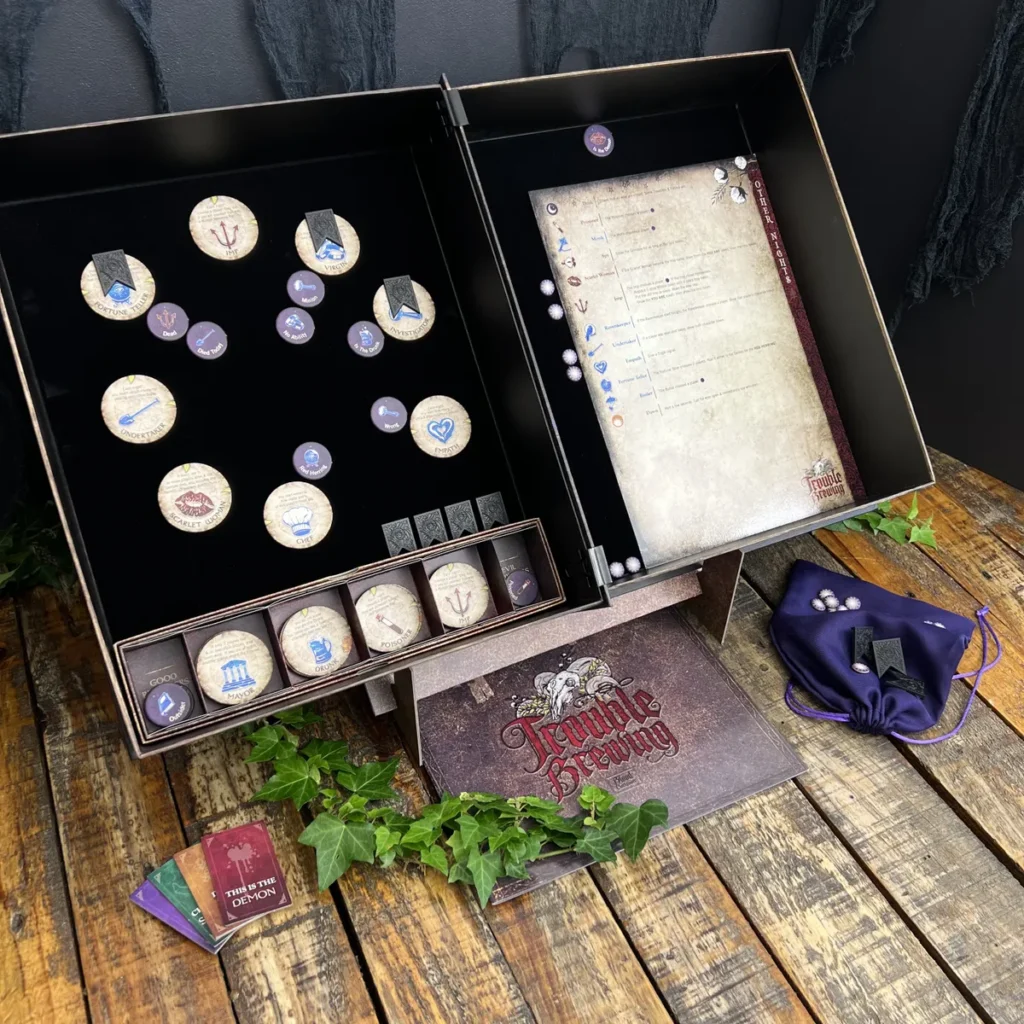
The Storyteller controls the game – they wake players in a set order each night, give information, and make judgment calls. Some abilities give true information. Others can be corrupted by the Poisoner or the Drunk. That tension – “is my information real?” – is what makes Blood on the Clocktower so compelling.
That tension – “is my information real?” – is what makes Blood on the Clocktower so compelling.
The Townsfolk (Good Team)
Townsfolk are the backbone of the good team. They gather information, protect allies, and create the deductions that let the village identify the Demon. There are 13 Townsfolk in Trouble Brewing.

On the first night, the Washerwoman learns the names of two players and is told that one of them is a specific Townsfolk character. The other player could be anyone. It’s a gentle starting clue – useful for confirming a role claim, and a foundation to build on.

Like the Washerwoman, but for Outsiders. On the first night, the Librarian learns which two players include a specific Outsider – or, if there are no Outsiders in the game, is told so directly. Important early context for the village.
Same structure again, but for Minions. The Investigator learns two players and is told one of them is a specific Minion character. This is powerful information – Minion knowledge is hard to come by, and a confirmed Minion pair is a serious lead.

On the first night, the Chef learns a number: how many pairs of evil players are sitting directly next to each other around the circle. Zero means the evil team is well-spread. Two or three means some evil players are adjacent – watch those clusters.

Every night, the Empath wakes and learns how many of their two living neighbours are evil. The number shifts as players die and seats become adjacent. Track it across multiple nights and you can start to triangulate who’s evil.

Each night, the Fortune Teller chooses two players and learns whether either of them is the Demon. Important catch: one player in the game is a “red herring” who registers as the Demon even though they’re good. The Fortune Teller doesn’t know who the red herring is. This keeps the information useful but never definitive.
On each night after the first, the Undertaker learns the character of whoever was executed that day. Useful for tracking claimed roles, catching bluffs, and confirming (or contradicting) what players said about themselves before they died.
Each night except the first, the Monk secretly chooses a player to protect. If the Demon tries to kill that player, the kill fails. The Monk doesn’t learn whether the protection worked, but a player who somehow survives a night when they should have died is often a clue.

The Ravenkeeper’s ability only triggers when they die at night – killed by the Demon. When that happens, they immediately wake and choose any player to learn their character. It’s a posthumous piece of information that can break a game wide open if aimed correctly.

If the Virgin is nominated by a Townsfolk for execution, that Townsfolk is immediately executed instead of the Virgin. This creates a fascinating dynamic: good players are hesitant to nominate the Virgin (in case they die), while evil players can nominate freely since Minions and the Demon are not Townsfolk.

Once per game, during the day, the Slayer can publicly declare they are using their ability on a named player. If that player is the Demon, they die immediately. If not, nothing happens. It’s a one-shot nuclear option – use it when you’re confident, and use it loudly so the village believes you.
The Soldier is immune to the Demon’s kill. The Demon simply cannot kill them at night. This is a powerful defensive role that also makes the Soldier a valuable target for the Poisoner (negating their immunity) and a useful blocker in the late game.

Two separate abilities. First: if the game reaches just three living players and no execution has occurred that day, the good team wins. Second: if the Demon tries to kill the Mayor at night, the attack might be redirected to another player instead, at the Storyteller’s discretion. The Mayor is the good team’s endgame insurance policy.
The Outsiders (Good Team)
Outsiders are on the good team but their abilities generally harm or complicate the village rather than help it. They’re a deliberate wrench in the works. There are four Outsiders in Trouble Brewing, though the Baron can add more to the game.

Each night, the Butler secretly chooses a “master” – any player except themselves. During the following day, the Butler may only vote if their master also votes. It’s a significant restriction, especially as the game tightens. Smart Butlers choose good-team players they trust.

Here’s the cruel twist: the Drunk believes they are a Townsfolk character. They were given a character token, they woke for abilities, they received information – but none of it is real. The Storyteller gives them false or meaningless results. The Drunk doesn’t know they’re the Drunk until it’s often too late.
The Recluse may register as evil to other characters’ abilities, and may register as a specific Minion or Demon. This can confuse every information-gathering Townsfolk in the game. Investigators, Fortune Tellers, and others can receive results pointing to the Recluse as evil when they’re actually good. Chaos in human form.

Straightforward and devastating: if the Saint is executed by the village, the good team immediately loses. The Saint creates enormous pressure on the nomination and voting process. If a player claims to be the Saint and the village isn’t sure, executing them is a massive risk.
The Minions (Evil Team)
Minions know who the Demon is from the start of the game, and they know each other. Their job is to sow confusion, protect the Demon, and keep the good team guessing. There are four Minions in Trouble Brewing.
Each night, the Poisoner secretly chooses a player. That player’s ability malfunctions from that moment until dusk the following day – giving false information, not firing at all, or simply not working. The Poisoner is perhaps the most disruptive role in the game: every piece of information becomes suspect when you don’t know who’s been poisoned.

Each night, the Spy may look at the Grimoire – the Storyteller’s record of every player’s character, status, and notes. They see everything. Additionally, the Spy may register as good to abilities, and as a Townsfolk or Outsider. An experienced Spy with full information is one of the most powerful roles in the game.

A safety net for the evil team. If the Demon dies while five or more players are still alive, the Scarlet Woman immediately and secretly becomes the Demon. The village thinks they’ve won – but the game carries on. A clutch ability that turns apparent defeats into victories.

The Baron doesn’t have a nightly ability. Instead, their mere presence in the game changes the setup: there are two additional Outsiders among the players. The Storyteller adds extra Outsiders to the mix, meaning there are fewer Townsfolk providing useful information. Simple, structural, and quietly devastating.
The Demon (Evil Team)
There is only one Demon in Trouble Brewing.

Each night, the Imp kills a player of their choice. Standard enough. But here’s what makes the Imp uniquely interesting: if the Imp chooses to kill themselves, they die – and a living Minion is secretly told they are now the Imp and becomes the new Demon. This allows an experienced Imp to pass the mantle before the village closes in – making it much harder to win by simply finding and executing the Demon.
Playing Blood on the Clocktower at Draughts
If all of this has you itching to play, we’ve got you covered. Blood on the Clocktower is in our library here at Draughts in Queen Elizabeth Olympic Park – along with hundreds of other social deduction, strategy, and party games spread across our 1,000+ game collection.
We’re a bar, restaurant and board game cafe at 5 Aquatics Walk, E20 2AS – right inside the park. Come grab a table, get the Grimoire out, and let the lying begin. Groups of 8-15 are ideal for a full game, though we can help you pick the right format for your group size.


Book your table at draughtslondon.com – we’d recommend booking ahead, especially on weekends.
Practical Tips for First-Time Players
- Start with Trouble Brewing. The three official scripts are Trouble Brewing, Bad Moon Rising, and Sects & Violets – Trouble Brewing is designed for new players.
- You need a Storyteller. One player runs the game rather than playing. This is a commitment but also brilliant fun – the Storyteller has full information and shapes the experience.
- 10-15 players is the sweet spot. Blood on the Clocktower can technically run from 5 to 20, but 10-15 gives you the richest mix of roles.
- Trust your gut, then check your logic. The game rewards both emotional reads and careful deduction. The best players use both.
- Lying is part of the game. Every player – good and evil – has reasons to bluff at some point. Don’t take it personally.
Frequently Asked Questions
How many roles are in Blood on the Clocktower Trouble Brewing?
Trouble Brewing contains 13 Townsfolk, 4 Outsiders, 4 Minions, and 1 Demon – 22 characters in total. Not all are used in every game; the Storyteller selects a mix appropriate to the player count using the role sheet included in the box.
What is the Drunk in Blood on the Clocktower?
The Drunk is an Outsider who believes they are a Townsfolk. They receive a Townsfolk token and wake for abilities each night, but the Storyteller gives them false or meaningless information. They don’t know they’re the Drunk – making it one of the most devious roles in the game.
What does the Imp do in Blood on the Clocktower?
The Imp is the only Demon in Trouble Brewing. Each night, the Imp kills a chosen player. If the Imp kills themselves, they die – and a living Minion secretly becomes the new Imp. This allows the evil team to change their Demon mid-game.
What is the difference between Townsfolk and Outsiders?
Both Townsfolk and Outsiders are on the good team. The difference is that Townsfolk abilities generally help the village gather information and identify evil players, while Outsiders have abilities that complicate or hinder the good team. Outsiders are still trying to help good win – they’re just awkward about it.
What does the Poisoner do?
Each night, the Poisoner secretly chooses a player whose ability malfunctions until the following dusk. This means information-gathering roles receive false results, protective roles don’t fire, and the good team can’t be certain any of their information is reliable.
What is the Scarlet Woman?
The Scarlet Woman is a Minion whose ability triggers if the Demon dies while 5 or more players are alive. In that case, the Scarlet Woman secretly becomes the new Demon – and the game continues. The village believes they’ve won, but the Demon is now elsewhere.
Can the Recluse be mistaken for evil?
Yes – intentionally. The Recluse may register as evil to character abilities and as a Minion or Demon specifically. An Investigator might learn that the Recluse is a Spy (false), or a Fortune Teller might ping the Recluse as the Demon (also false). The Recluse is good but causes real confusion.
What does the Baron do in Blood on the Clocktower?
The Baron doesn’t have a nightly ability. Instead, their presence in the game adds two additional Outsiders to the mix. The Storyteller adjusts the setup accordingly, which means fewer Townsfolk providing useful information to the good team.
What does the Spy do?
Each night, the Spy can look at the Storyteller’s Grimoire – seeing every player’s role, alive or dead, and any relevant notes. They can also register as good and as a Townsfolk or Outsider to other abilities. A Spy with full information is one of the most powerful roles in the entire game.
What happens if the Mayor is attacked by the Demon?
If the Demon tries to kill the Mayor at night, the Storyteller may redirect the kill to another player instead. This isn’t guaranteed – it’s at the Storyteller’s discretion – but it means the Mayor has a degree of protection. If the Mayor survives to three living players and no execution occurs that day, the good team wins.
Where can I play Blood on the Clocktower in London?
We have Blood on the Clocktower in our library at Draughts in Queen Elizabeth Olympic Park, Stratford. We’re at 5 Aquatics Walk, E20 2AS – a short walk from Stratford station and Maryland overground. Book a table at draughtslondon.com.
What’s the best player count for Blood on the Clocktower?
Most players find 10-15 the sweet spot. You get a full mix of roles, the deduction is rich, and no one sits out. The game can technically run from 5 to 20 players, but the magic really kicks in around double figures.
Is Blood on the Clocktower available to buy in the UK?
Yes – The Pandemonium Institute, who publish the game, sell direct from bloodontheclocktower.com and ship to the UK. It’s a premium box with beautiful components, but if you want to try before you buy, come play with us at Draughts first.